What Parents Should Know About Kids and AI Chatbots
AI chatbots are programs that generate conversational answers, and children can use them for everything from homework to personal questions. The same chat box can act like a tutor, a search tool or a pretend friend, which makes a single rule about “using AI” too vague.
Start by finding out what your child actually does with it. A request for help understanding fractions raises different questions from hours spent talking privately with a character designed to feel like a companion.
Ask to See an Ordinary Conversation
You don't need a dramatic example to begin. Ask your child to show you a typical task and explain what they find useful, frustrating or funny about the response.
Try one together using a topic you both know. Notice whether the chatbot answers the question, admits uncertainty and changes its answer when challenged, then check an important detail outside the chat.
Explain that a chatbot can sound friendly and certain while being wrong. Its conversational style doesn't mean it knows your child or can judge what is best for them.
Pew Research Center's February 2026 report found that 54% of American teens ages 13 to 17 had used chatbots for schoolwork. The survey took place in fall 2025, and it also found a gap between teens' reported use and parents' awareness.
Separate Learning From Producing the Assignment
A chatbot can explain a step, offer a practice question or give feedback on a student's reasoning. It can also produce a finished answer that leaves the student with very little understanding of how it was reached.
A useful request might be: “Give me one practice problem about fractions, wait for my answer, then explain any mistake.” Use a fresh example rather than asking it to complete the assignment the student must submit.
Afterward, have the child explain the idea without the chat open. If they can only repeat the generated wording, another explanation or a teacher's help may be needed.
Check the school's rules for each assignment. Permission to use AI for brainstorming doesn't necessarily include permission to have it write the response, and different teachers may draw the line differently.
Don't make an AI detector the referee at home. A score can't reliably reconstruct the writing process, so drafts, discussion and the child's understanding are more useful places to start.
Teach What Belongs Outside the Chat
Set a practical rule about personal information before it appears in an upload. A worksheet photo can reveal a full name, school, class and other children in the background.
Keep addresses, passwords, private family details and other people's messages out of casual experiments. An assistant doesn't need a real name or school to explain a math problem.
Show how sharing works, too. Creating a link to a conversation can make more of it visible than the child intended, so review the actual shared content before sending it anywhere.
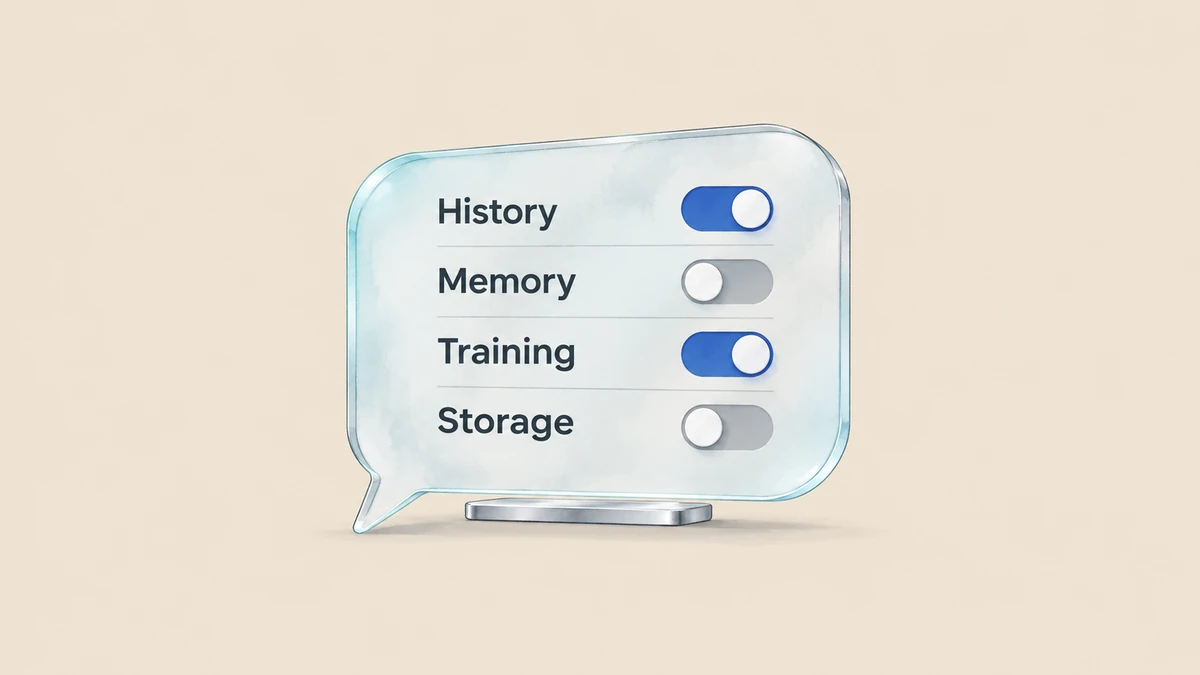
Our chatbot privacy guide explains history, memory and training as separate features. Even with restrictive settings, a cloud service still processes information sent to it under its applicable terms.
A Pretend Friend Needs a Different Conversation
An AI companion is designed or used for ongoing social conversation. Names, voices and remembered details can make it feel personal, but the responses come from software and don't establish a relationship with a person who knows the child's circumstances.
Common Sense Media's 2025 research on teen companions examines uses ranging from entertainment to serious conversation. Its findings shouldn't be treated as a description of every child or every chatbot.
What Teens Say About Talking to AI Companions
Talk about the difference between rehearsing a conversation with a bot and relying on it to decide what to do about a serious problem. Identify real people the child can turn to, including when a chatbot's response feels upsetting or inappropriate.
Make it clear that they can show you a troubling answer without being blamed for receiving it. That invitation is more useful than expecting them to recognize every problem alone.
Make the Rules Fit the Child and the Service
Check the service's current age requirements and parental settings before allowing an account. Controls vary, and an age label or safety setting doesn't guarantee every response will be appropriate.
Agree on when the tool is used, what may be shared and which questions should go to an adult. Revisit those rules as the child's needs and the product change.
AI systems also make judgments that work unevenly across different groups. Joy Buolamwini's account of testing face-analysis systems is useful background for parents who want to question a confident machine-generated label.

- Learn how one researcher showed that face recognition fails some people more than others.
- Understand algorithmic bias through a personal story, not a textbook.
- Come away knowing what questions to ask of any AI system.
Pay attention to whether use is crowding out sleep, schoolwork or time with other people. If a child seems distressed or unable to step away, involve a qualified professional who can consider the situation beyond the screen.
Keep the conversation ordinary enough to repeat. “What did the chatbot help with today, and what did it get wrong?” leaves room for both curiosity and a healthy amount of doubt.
Is Your AI Chat Private? The Settings That Matter
Why AI Makes Things Up—and Sounds So Sure About It

How to Ask AI Better Questions Without the Magic Words

QUOTE:
"Amateurs hack systems, professionals hack people."