Honeypots: How a Decoy Turns Suspicious Visits Into Evidence
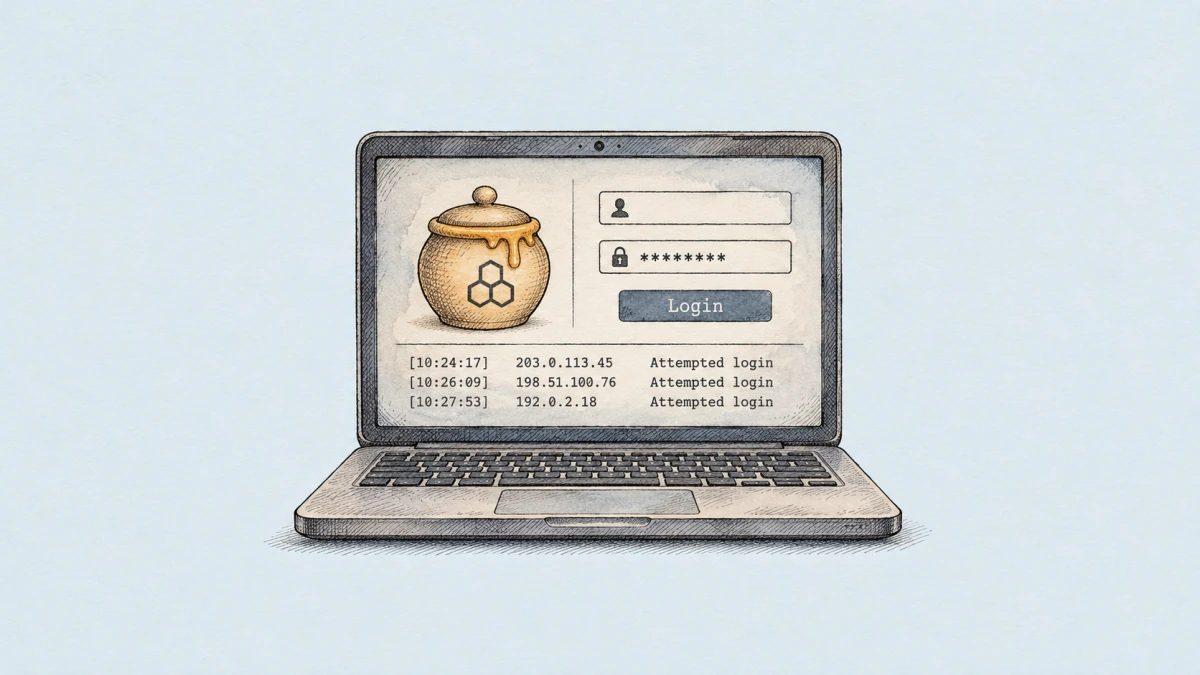
A honeypot is a decoy computer service or resource that defenders monitor for suspicious activity. It gives an intruder something convincing to interact with—and gives the security team a chance to see what happens.
The target might imitate a login service, offer invented files, or resemble a larger working system. As the National Institute of Standards and Technology's definition makes clear, a honeypot can be a resource such as a file, not necessarily a whole computer.
Decide what the decoy should reveal
A useful honeypot starts with a question. Is someone trying passwords against an exposed service, searching an internal network for machines, or opening documents they shouldn't need?
The placement changes the meaning of the evidence. A decoy open to the internet may attract routine automated scanning; a connection to an unused internal service may deserve a different investigation.
Security research organization MITRE's description of decoy environments emphasizes logging and analyzing communication that has no legitimate business purpose. Its examples include both decoys placed among working systems and separate research environments.
The Trap Built to Be Attacked
Here are some possible observations, with the limits kept attached:
| Observation | What it can tell the team | What it doesn't establish |
|---|---|---|
| Repeated login attempts | Which names and passwords are being tried | Who personally made the attempts |
| Commands entered after access | What that visitor tried to do next | Everything the visitor did elsewhere |
| Contact from an internal address | Which connection deserves investigation | Whether it came from an attacker or an authorized test |
For a concrete example, Cowrie records attempts against remote-login services and can capture commands. Remote login lets someone operate a computer over a network; Cowrie can imitate that experience or record interaction with another system.
A convincing imitation doesn't need to contain valuable information. Invented documents and a simulated command interface can give defenders observations without handing over the real payroll files.
An alert starts the investigation
Suppose the decoy records a connection from a staff computer. The team can compare its time and address with records from that computer and other network systems before deciding what happened.
The connection might come from malicious software, but it could also come from an approved tool checking the network. Treating every visitor as a confirmed intruder would make the decoy's alerts less useful.

- Start tonight: the board, case, power supply and memory card are all in the box.
- Run a home lab, an ad blocker or a practice server on one small computer.
- Learn Linux hands-on without risking your main machine.
The design also affects what can go wrong. A limited imitation offers fewer functions to misuse than a realistic system that lets a visitor run programs, though either still needs careful operation.
The T-Pot honeypot project's documentation warns that compromise can't be ruled out and that honeypots shouldn't store sensitive information. Operators need to control access to real systems and restrict the decoy's outgoing connections.
Someone must review the records, investigate useful alerts, and maintain or reset the environment. A decoy that collects evidence nobody reads has little chance to improve a response.
Honeypots also miss attacks that never interact with them. They complement monitoring of working systems; they don't replace software updates, access controls, or recovery plans.
Judge a honeypot by the useful questions its evidence helps answer, not by how many visitors it attracts. A large stack of login attempts isn't the same thing as a confirmed breach of the business.
Honey Clients: The Test Browsers That Go Looking for Trouble

Intrusion Detection: How Suspicious Activity Becomes an Alert
Cliff Stoll: The 75-Cent Clue Behind The Cuckoo's Egg

QUOTE:
"Amateurs hack systems, professionals hack people."