Payment-Card Skimmers: The Hidden Copy Behind a Normal Transaction
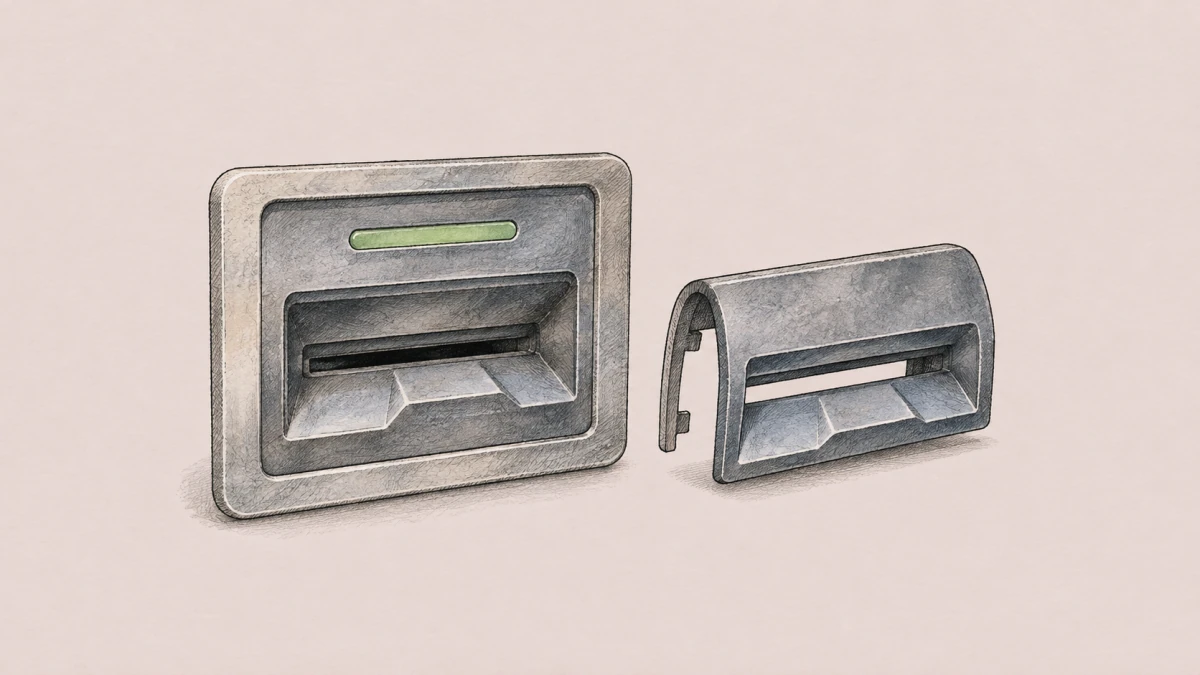
A card reader can complete a payment while hidden equipment makes a second, unauthorized copy of the card information. From the customer's side, the transaction may appear ordinary. The extra collection is the work of a payment-card skimmer.
A skimmer may sit over a reader, hide inside a terminal or intercept information through altered connections. It doesn't have to be an obvious attachment on the outside. The Payment Card Industry (PCI) Security Standards Council's physical skimming examples document several of these arrangements.

- Stop anyone from scanning your contactless cards in a crowd.
- Find the right card fast with numbered, color-coded sleeves.
- Protect a whole family's cards and passports with one inexpensive set.
A Card and a PIN Leave Different Trails
A magnetic stripe carries card data. It doesn't contain the personal identification number, or PIN, that the cardholder enters into a keypad.
An attack seeking both therefore needs more than the stripe reader. The FBI describes skimming equipment paired with cameras or keypad overlays. The camera watches the PIN entry. An overlay placed over the real keypad records the keys pressed.
This separates two kinds of theft that a customer may experience as one ordinary transaction. One device copies information from the card; another obtains the entered secret. The collected information may be stored for later retrieval or transmitted wirelessly.
Covering the keypad can obstruct a camera's view. It doesn't stop every keypad-recording method or protect the card data passing through a compromised reader.
Loose or unusual terminal parts are reasons to avoid the reader and notify its operator. A normal appearance can't rule out equipment hidden inside. Monitoring transactions and contacting the card issuer after suspected compromise provide follow-up when the theft itself was not visible.
Why Copying a Stripe Isn't Copying a Chip
A chip transaction does more than present the same stored card details each time. Under the EMV chip-payment standards, a contact chip generates a transaction-specific cryptogram, a calculated value that helps establish that the card is authentic for that transaction.
EMVCo explains this mechanism in its contact-chip guidance. Copying magnetic-stripe details doesn't reproduce the chip's ability to generate that proof for a new payment.
Stolen details may still support fraud where those details are sufficient and the payment controls allow it. The chip's protection limits a particular use of a copy; it doesn't make every payment safe.
What Does the Chip in Your Card Actually Do?
Online Skimming Moves the Collection Point
A website checkout has no physical reader to inspect. E-skimming instead targets payment details entered in the browser, often through malicious or compromised scripts—programs running within the payment page.
The collection happens where the information is being entered. An HTTPS connection can protect data traveling to the server without establishing that every script on the page is trustworthy.
The merchant has controls available that an ordinary shopper cannot perform by looking at the checkout. PCI's 2025 payment-page security guidance addresses approving scripts, checking that their code hasn't been altered and detecting unauthorized changes to the payment page. Here, the object being inspected is the code handling payment information, rather than the plastic surrounding a card slot.
RAM Scraping: Stealing Data While a Program Uses It
Data Theft: What Happens When Someone Takes Your Information
All 4 PCI Compliance Levels Explained
QUOTE:
"Amateurs hack systems, professionals hack people."