Hacktivism: When Cyberattacks Carry a Political Message
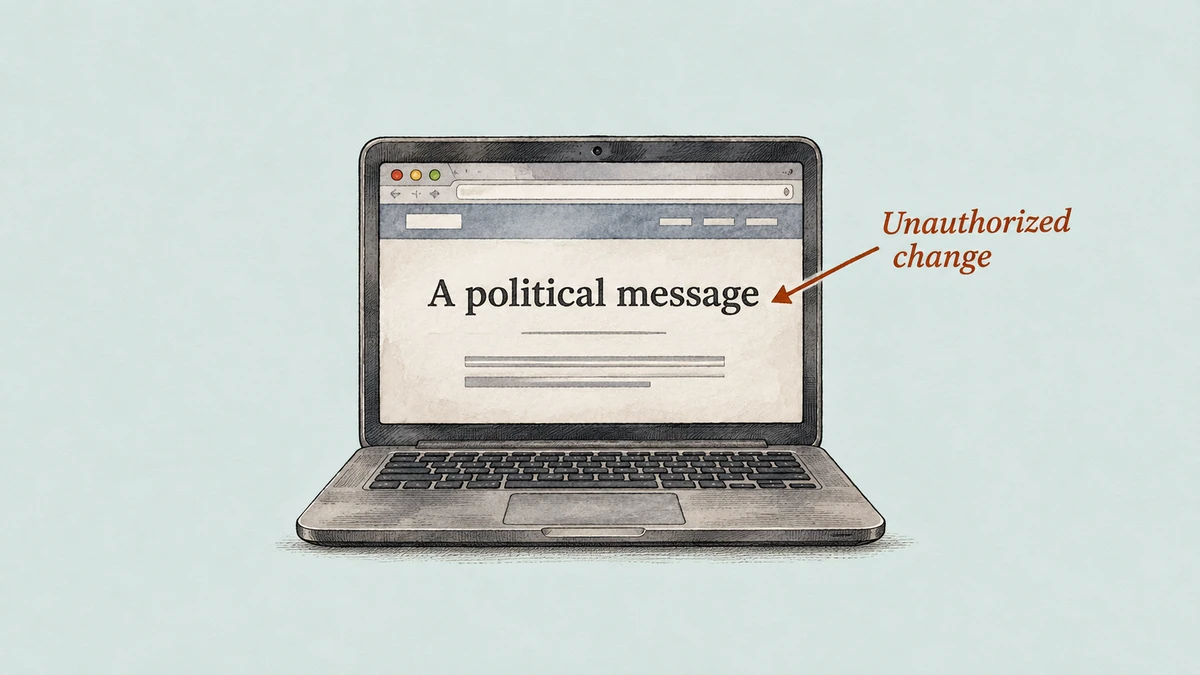
A political slogan suddenly replaces a website's home page, and a group posts a triumphant message claiming responsibility. That could be hacktivism: using hacking or digital disruption to advance a political, social, or ideological cause.
The term joins hacking and activism, but it doesn't cover every campaign conducted online. Publishing criticism, organizing a petition, and breaking into someone else's website are different activities, even when they promote the same cause.
Hacktivism describes the stated purpose of an action, not one particular technique. It also doesn't tell you whether the attacker achieved what they claimed.

- Meet the hacking group that helped invent hacktivism.
- See how a crew from Texas bulletin boards ended up influencing Washington.
- Understand where today's security industry came from.
What an attack can actually do
The results depend on the method. Three activities often discussed under the hacktivism label affect victims in different ways:
- Website defacement changes a site's appearance or content without its owner's approval, often to display a message.
- Distributed denial of service, or DDoS, uses traffic from multiple sources to overwhelm a service and make it harder or impossible to use.
- Data theft and publication exposes information taken from a system, potentially including records about people who have no part in the dispute.
The Canadian Centre for Cyber Security identifies political and social causes among the motives for defacement. It also warns that a defaced site can carry malicious code, so the visible slogan may not be the only problem.
These outcomes aren't interchangeable. An unavailable website doesn't prove anyone stole its database, and an altered home page doesn't establish how far an intruder reached into the organization.
The boast and the evidence
For an attacker seeking attention, a screenshot and an alarming claim may travel much farther than the technical evidence of an attack.
In its 2025 threat landscape findings, the European Union Agency for Cybersecurity reported that hacktivist activity in its EU-focused sample was dominated by low-impact DDoS campaigns against websites. A large number of announced attacks therefore shouldn't be read as an equally large number of major breaches.
That doesn't make every such operation harmless. In December 2025, the National Security Agency and partner agencies warned that pro-Russia hacktivist groups had accessed poorly secured systems controlling physical equipment.
The agencies said those groups exaggerated attacks for publicity, yet had also caused damage to vulnerable infrastructure. A group's boasting and a real threat can exist at the same time.
An FBI Agent Explains Anonymous
A cause doesn't identify the operator
A group saying it supports a country or movement isn't proof that it represents that country or movement.
The European agency's 2025 findings also described break-ins by groups aligned with governments that were presented as hacktivism. A public identity built around protest can conceal a different relationship or purpose.
For readers, the useful questions are concrete: Did the service stop working, was information exposed, or did someone change a system? Look for confirmation from the affected organization or investigators, alongside a clear account of what remains unknown.
The motive can explain why a target was chosen. It doesn't erase the consequences for a patient, customer, or employee whose information or access gets caught in the attack.
Website Defacement: Why Fixing the Homepage May Not Be Enough

Distributed Denial of Service: Beyond Blocking IP Addresses
Information Warfare: How Messages Become a Means of Conflict
QUOTE:
"Amateurs hack systems, professionals hack people."