Diffie–Hellman: How Two Computers Agree on a Secret
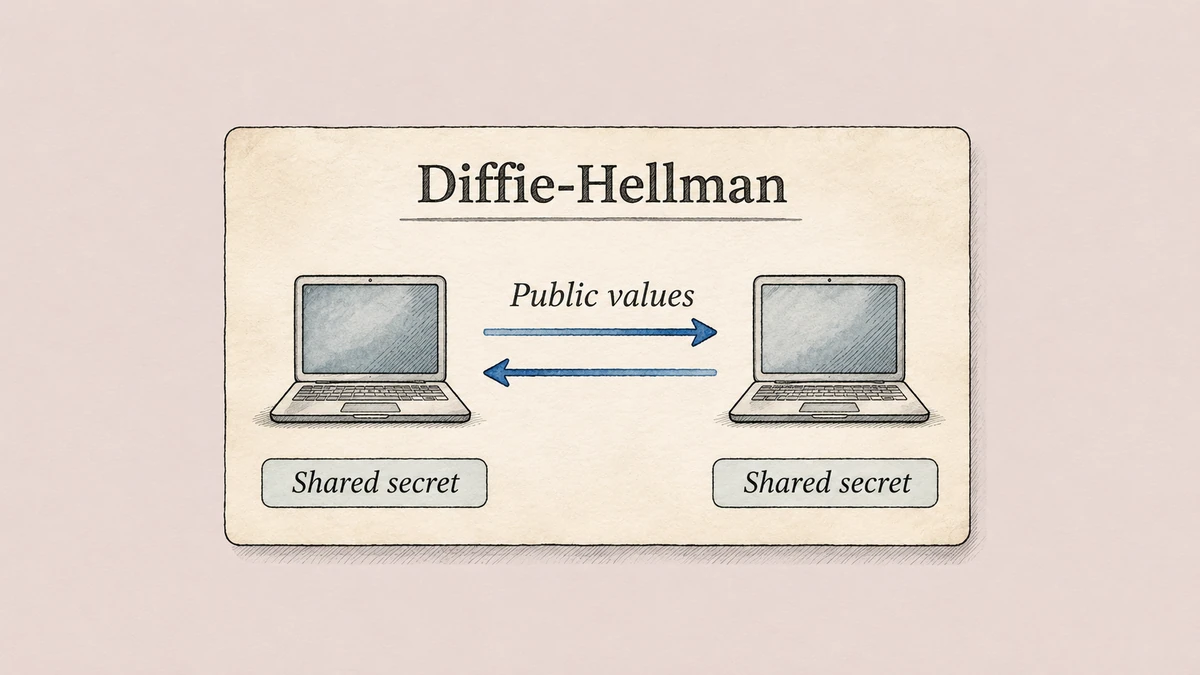
Two computers want to start a private conversation. There's one awkward detail: they don't yet share a secret, and someone could be listening to everything they send.
Diffie–Hellman is a method that lets the computers create the same secret by exchanging public information. Neither computer sends its private value or the finished secret across the connection.
That may sound like a contradiction. If a listener hears the exchange, shouldn't they have everything the computers have? The missing ingredients are the private values. Each computer keeps its own, and the mathematics lets both arrive at the same answer without revealing those ingredients.
The method solves a particular problem called key agreement. It doesn't encrypt the conversation or prove who's on the other end. A secure connection needs those jobs done, too.

- Understand what AES, RSA and hashing actually do before you rely on them.
- Learn to spot the mistakes that break real-world encryption.
- Get a practical introduction to modern encryption in one book.
A Secret Built at Both Ends
Encryption turns readable information into a form that someone without the right key can't readily understand. An encryption key is a value used by the software that scrambles or restores that information.
Before two computers can use a shared encryption key, they need a way to establish it. Sending the key openly would hand a listener the very thing meant to keep the conversation private.
Diffie–Hellman takes another route. Imagine two devices starting a connection:
- Each chooses a private value. Both devices use agreed mathematical settings, which can be public. Each keeps its own private value secret.
- Each calculates and sends a public value. This calculation uses the device's private value and the public settings. The public result is designed to be shared.
- Each calculates the shared secret. The first device combines its private value with the second device's public value. The second does the reverse. The results match.
The listener can collect both public values and the public settings. They don't have either private value. With suitable mathematics and a correct implementation, working out the shared secret from the public information is designed to be too difficult to be practical.
This isn't a promise of unbreakable secrecy. Poor choices, weak randomness when creating private values, or flaws in the software can undermine the protection.
The shared secret then feeds another calculation that produces usable encryption keys. The technical specification for Diffie–Hellman key agreement describes these as separate stages: first establish the secret, then derive key material from it.
The Number Trick Behind a Shared Secret
Once that's done, encryption software can use the resulting keys to protect the messages. Diffie–Hellman's part was helping the devices agree on secrets before those messages began.
The Listener Who Starts Talking
So far, the listener has stayed quiet. The harder case is an attacker who can intercept and replace the public messages.
Imagine that attacker swaps in their own public values as two devices try to connect. One device unwittingly agrees on a secret with the attacker. The other device does the same. The attacker now has two separate secrets, one for each connection.
That can let the attacker read a message on one connection and send it along, encrypted again, on the other. Each device may think it's speaking directly to its intended partner.
This is a man-in-the-middle attack: someone places themselves between the intended participants and interferes with their communication. The underlying key agreement can work exactly as designed while the participants agree on secrets with the wrong person.
The TLS specification's discussion of anonymous Diffie–Hellman makes that limitation clear. Protection against passive listening doesn't, by itself, stop an active impostor.
- Put your whole home behind a VPN at speeds up to 1,100 Mbps.
- Stay online when one provider fails, with multi-WAN failover.
- Reach your home network securely while you travel.
The missing piece is authentication, the process of checking an identity. A complete communication protocol—a set of rules that devices follow—can combine Diffie–Hellman with those checks.
For example, TLS, short for Transport Layer Security, is a protocol for protecting network connections. It can use a digital signature: a mathematical check that shows a particular private key was used to sign some information. Other computers check the signature using the matching public key.
In a certificate-based TLS 1.3 connection, the server, or computer providing the service, signs the exchange to prove it holds the private key named by its certificate. A certificate is a digital record that links a public key to an identity. Checking that record and the signature helps establish who took part in the key agreement. Bare Diffie–Hellman doesn't provide those identity checks.
How Do You Send a Secret Without Sharing a Secret First?
Why Temporary Keys Matter
A further choice changes what happens if a secret is stolen later.
An ephemeral Diffie–Hellman exchange uses temporary exchange keys. “Ephemeral” simply means short-lived. Fresh values can be created for a new connection, rather than relying on the same exchange keys indefinitely.
You may see the abbreviation DHE for this approach. ECDHE adds elliptic-curve mathematics, a different mathematical method for carrying out the same kind of key agreement with temporary keys.
Consider an attacker who records encrypted conversations today, then steals a server's long-term identity key next month. That identity key proves who the server is; it isn't the same thing as a temporary Diffie–Hellman private value.
With a correctly designed temporary exchange, stealing the identity key later doesn't by itself reveal the keys for those recorded conversations. This protection depends on securely deleting the temporary private values and session secrets when they're no longer needed. It's called forward secrecy. A session here means one period of communication between the devices.
The TLS 1.3 security analysis explains this protection and its limits. The protocol's mode matters: some modes rely on an already shared secret without a fresh Diffie–Hellman exchange, so the label “TLS” alone doesn't establish forward secrecy.
Nor does forward secrecy keep a conversation private from an attacker who already controls one of the computers and can read it there. It's protection against a particular consequence of later key theft, not a promise against every attack or future mathematical breakthrough.
If a service promises forward secrecy, the useful details are which connections receive it and how temporary secrets are handled. The words “uses Diffie–Hellman” don't answer those questions on their own.
What Is a Public Key, and Why Is It Safe to Share?
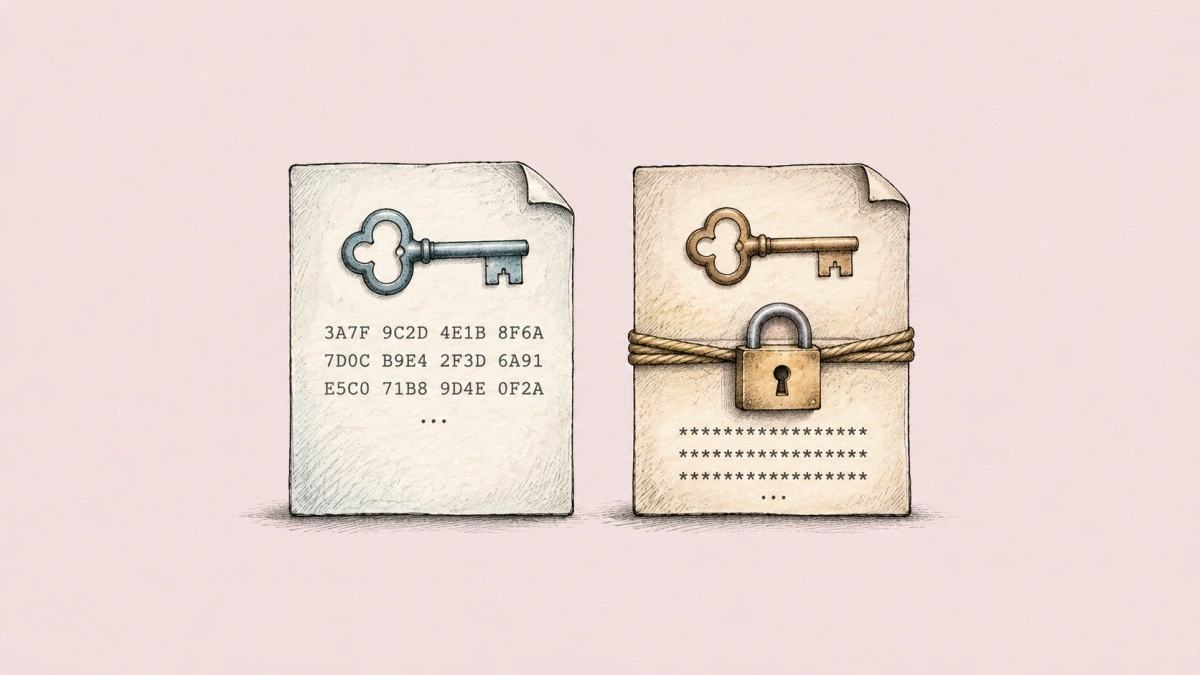
Session Keys: Temporary Secrets for a Protected Exchange
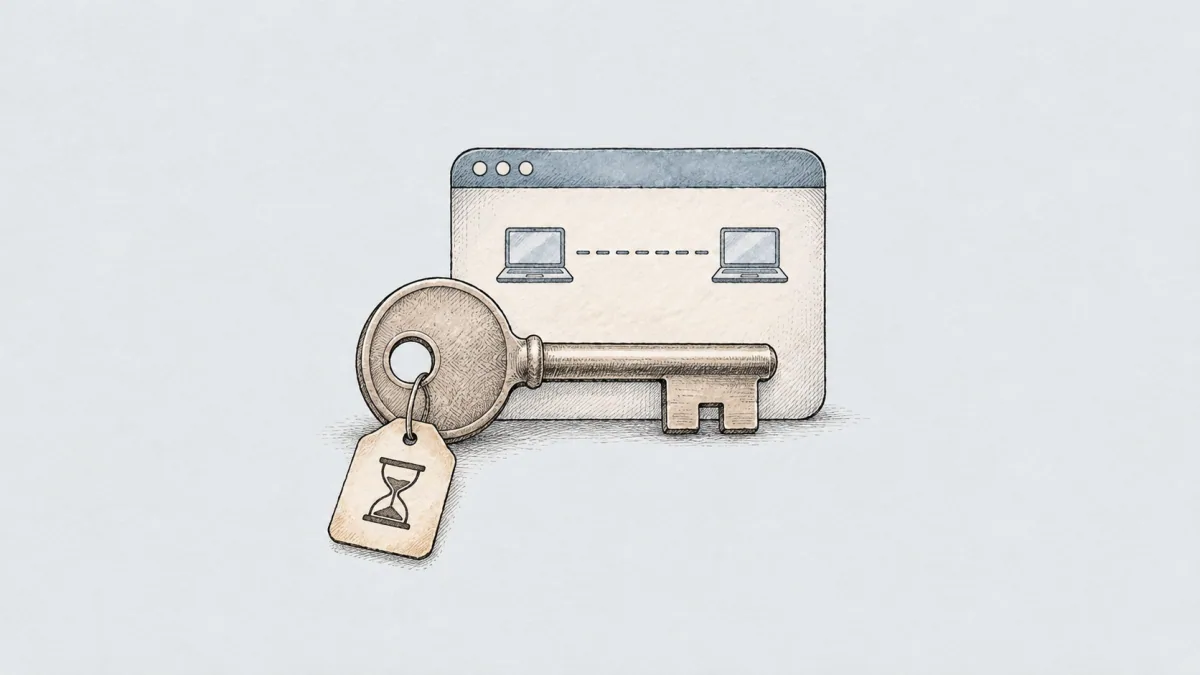
Perfect Forward Secrecy: Protecting Yesterday’s Traffic
QUOTE:
"Amateurs hack systems, professionals hack people."