Marvin Minsky and the Idea of a Mind Made of Many Parts
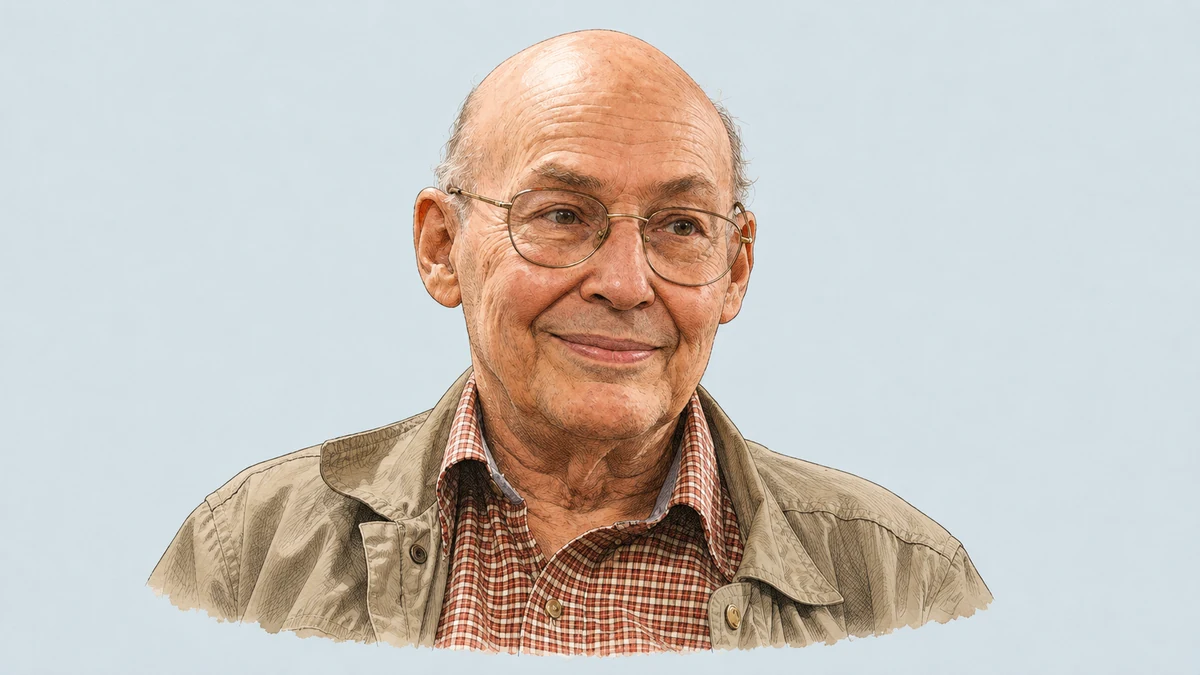
Marvin Minsky was a computer scientist at MIT who helped establish artificial intelligence as a field. In his book The Society of Mind, he explored how many smaller processes, none intelligent on its own, might combine to produce a mind.
Picking up a toy block gives the idea a concrete starting point. It requires finding the block, recognizing it and controlling a hand well enough to lift it. Minsky spent decades investigating how such abilities worked, beginning with machines that could change their responses through experience.
The Learning Machine Before the Theory
Minsky was born in New York in 1927 and served in the U.S. Navy during World War II. He graduated from Harvard in 1950, then completed a mathematics doctorate at Princeton in 1954.
His early research was closely tied to the brain. In the summer of 1951, he and Dean S. Edmonds Jr. built an experimental learning machine at Harvard's Psychological Laboratory. They called it SNARC, short for Stochastic Neural-Analog Reinforcement Calculator.
The machine was an early neural network, a system of linked processing units inspired by connections in the brain. Reward signals made some paths through the network more likely to be followed again. That changed its responses with experience.
Minsky described the work in his doctoral dissertation, Neural Nets and the Brain Model Problem. Long before he became famous for criticizing certain neural-network designs, he was building one himself.
Minsky also began working with John McCarthy. In 1955, the two joined Nathaniel Rochester and Claude Shannon in proposing a summer research project at Dartmouth under the name artificial intelligence.
Their proposal for the 1956 gathering treated machine intelligence as a research possibility. Neural networks were among the approaches they wanted to investigate, along with language, abstraction and other problems.
Making Machines Deal With Objects
Minsky joined MIT's faculty in 1958 and helped start its AI research program with McCarthy. The work soon extended well beyond a machine that could solve a neatly written problem.
A robot faced a messier task. Before it could move an object, it needed some way to locate it, understand its position and choose an action. Even a small collection of blocks could force a researcher to connect seeing, describing and doing.
Minsky worked closely with Seymour Papert on questions of perception, knowledge and learning. Their 1971 progress report described a broad MIT program covering robotics, vision, analogy, language and education. Block arrangements and children's stories offered manageable settings in which to investigate larger questions about intelligence.
His interests also reached into tools for children and music. Minsky collaborated with Papert on the Logo programming language's turtle, which could draw by following commands, and with Ed Fredkin on the Muse music synthesizer.
The Perceptron Argument
In 1969, Minsky and Papert published Perceptrons, a mathematical examination of certain pattern-recognition systems.
Perceptrons, closely associated with psychologist Frank Rosenblatt, combine inputs into a score and use it to make a decision. Each input has a weight that determines how much it counts. Changing those weights can help a system classify examples correctly.
The simplest arrangement has a stubborn limit. With two input measurements, its decision rule can draw only a straight line between categories. If the examples are mixed so no such line separates them, more practice won't solve the problem.
Minsky and Papert studied a restricted class of models, including geometric recognition problems. Their results challenged expansive expectations for those machines.
Adding processing layers between the input and the answer could let a network handle patterns that the simpler arrangement couldn't. Both authors knew this, and Rosenblatt had also studied multilayer systems. The hard part was finding ways to train those extra layers. The book's mathematical limits applied to the models it analyzed, not to every possible neural network.
How Much Do You Know Before You Look?
Minsky was also interested in the expectations people bring to a situation before examining every detail. In 1974, he proposed a way to organize that knowledge. He called the structure a frame.
Think of entering a living room. You may expect seats and a place to put things, even before taking in the whole room. You can fill in details as you look, and revise your expectations if the room turns out to be unusual.
In A Framework for Representing Knowledge, Minsky described structures that hold expected features, relationships and places for particular details. They also need ways to handle information that doesn't fit.
His examples included living rooms and children's birthday parties. Knowing what sort of situation you're in can help you interpret a detail without rebuilding your understanding from nothing.
The proposal drew on earlier ideas about mental schemas, including Frederic Bartlett's work. A working system would also need ways to acquire, select and change its frames. Minsky left parts of those mechanisms open.
A Society Without a Tiny Boss
In his mid-1980s book The Society of Mind, Minsky argued that intelligent behavior could arise from the cooperation of much simpler processes. He called those smaller mental processes agents.
His imagined child building a tower provided an example. Finding a block, picking it up and adding it to the structure are different jobs. Each can be broken down further. No single part has to understand everything the child is doing.
Minsky was trying to explain intelligence without hiding another unexplained thinker inside the head.
Organization was crucial. A collection of unrelated parts doesn't automatically become a mind. The theory needed to explain how processes cooperate, compete and make use of one another's results.
Where Emotions Fit
Minsky became a founding member of the MIT Media Lab in 1985. His later work extended the argument to feelings, intuition and reflection.
In The Emotion Machine, published in 2006, he treated emotions as different modes of thinking. In his account, changing which mental processes were active could change the way a person approached a problem. Feelings belonged in an explanation of thought alongside reasoning.
Minsky continued teaching and mentoring at the Media Lab into his later years. He died in January 2016, aged 88. The Emotion Machine took up questions about the mind more than fifty years after he and Edmonds had built their learning apparatus.
John McCarthy Gave Artificial Intelligence Its Name
Frank Rosenblatt Was Teaching Machines to Learn in 1958

Geoffrey Hinton Helped Build Modern AI. Now He's Worried.
QUOTE:
"Amateurs hack systems, professionals hack people."