Frank Rosenblatt Was Teaching Machines to Learn in 1958
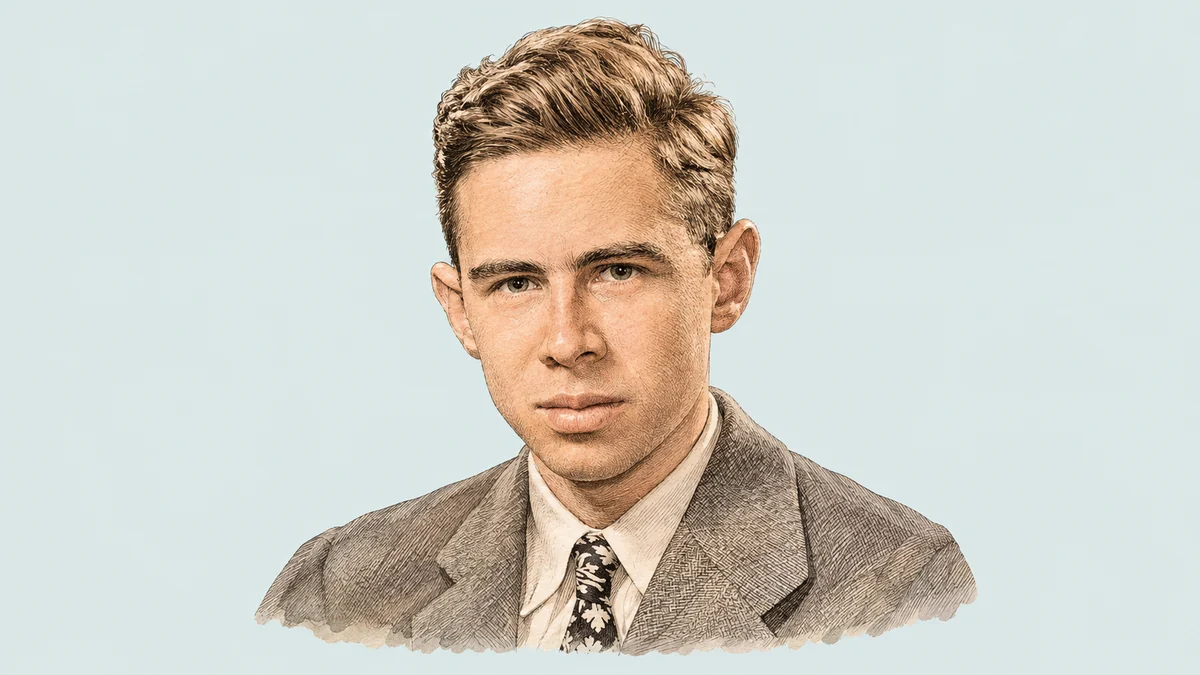
Frank Rosenblatt was a psychologist who developed the perceptron, an early learning system that used examples to improve how it recognized patterns. His research helped turn the idea of a machine learning from experience into experiments and working hardware.
In July 1958, he demonstrated the idea using an IBM 704 computer to distinguish cards marked on the left from cards marked on the right. After a series of trials, it made the intended distinction.
The publicity reached much further. A contemporary report reproduced in Cornell's teaching materials described Navy expectations for future machines that could talk or become conscious. Rosenblatt predicted that the proposed machine would think like a human brain and grow wiser through experience.
A Psychologist With a Computer
Rosenblatt was born in New Rochelle, New York, in 1928. He earned his undergraduate degree at Cornell in 1950 and completed a psychology doctorate there in 1956.
His interest in people already involved machines. During his doctoral work, he built an Electronic Profile Analyzing Computer to work with personality data. At Cornell Aeronautical Laboratory in Buffalo, he moved from research psychologist to head of its cognitive systems section.
The research questions were rooted in psychology. How does an organism take in information? How does it retain something from an experience? And how does that stored information affect what it recognizes or does next?
Rosenblatt wanted a model precise enough to investigate those questions. The perceptron, which he described in 1957, was one approach: a system of connected components whose responses could change with experience.
His 1958 paper placed the work in that biological context. He used the model to explore how a system could store information from experience and use it to recognize patterns later.
Learning Means Changing the Next Answer
A simple perceptron takes several inputs, combines them and makes a decision. Each input has a weight: a value that determines how much it counts toward the answer. The combined result is compared with a cutoff to choose a category.
For an image task, the inputs might come from different parts of a pattern. Some contribute more strongly to one answer, others to the alternative. Changing their weights changes which patterns produce which response.
In an error-correction version of perceptron learning, the system receives the expected answer during training. If it gets an example wrong, a rule adjusts the relevant weights. The next time it encounters that pattern, those inputs will count differently.
The researcher didn't have to choose every final weight in advance. For tasks the perceptron could handle, the learning procedure could find suitable values through repeated examples.
Rosenblatt also distinguished recognizing something already presented from generalizing: responding correctly to a new example of the same kind. Memorizing the training examples wouldn't be enough to establish that a machine could handle unfamiliar ones.
When a Weight Was an Electrical Setting
The July 1958 demonstration ran on the Weather Bureau's IBM 704. The physical Mark I perceptron was a separate piece of equipment developed at Cornell Aeronautical Laboratory.
Its controls make the idea of a weight unusually tangible. The machine used adjustable electrical components called potentiometers, with motors that could change their settings. A plugboard helped determine connections, while circuits and meters handled responses.
Changing a value could mean moving a physical component.
Rosenblatt's team turned the model into equipment and experiments. Charles Wightman and Francis Martin contributed to the Mark I's engineering, John Hay to its experimental program, and Louise Hay to programming work.
In his 1962 book Principles of Neurodynamics, Rosenblatt credited those contributors along with mathematicians H. D. Block and R. D. Joseph. He also recognized that motor-driven components would be impractical for very large systems.
When More Practice Won't Help
Repeated correction can teach a simple perceptron to separate certain categories. Whether it can succeed depends on how those categories are arranged in the information it receives.
With two numerical inputs, its decision boundary is a straight line. Points on one side receive one answer; points on the other side receive the other.
For an illustration of the problem, place four points at the corners of a square. Label two opposite corners A and the other two B. No single straight line can put both A points on one side and both B points on the other.
More practice can't solve that arrangement with the same simple decision rule. The system needs a different representation or additional processing that can form useful intermediate features.
In 1969, Marvin Minsky and Seymour Papert published Perceptrons, examining mathematical limitations of specified models, including geometric recognition problems. Their work challenged broad expectations for what those machines would learn.
Rosenblatt's own research went beyond the simplest design. His 1962 book had already investigated multilayer systems. Adding layers between the inputs and the final answer allowed more complicated patterns to be represented, as Minsky and Papert also knew. Finding effective ways to train those layers was a further challenge.
Back at Cornell
Rosenblatt returned to Cornell's Ithaca campus in 1959 as director of its Cognitive Systems Research Program and a psychology lecturer. In 1966, he joined Neurobiology and Behavior as an associate professor.
His interests extended beyond visual classification. He worked on speech-recognition research and biological questions about memory. He taught a course called Brain Mechanisms and Models, joining experimental work with ideas about how a brain might function.
Colleagues' memorial account also recalls interests in astronomy, music composition and political statistics, along with his concern for students.
Rosenblatt died in a boating accident in Chesapeake Bay on July 11, 1971, his 43rd birthday.
The Mark I had already found a longer-term home. It was transferred to the Smithsonian in 1967 and remains documented in the National Museum of American History's collection.
The surviving controls show what learning looked like in Rosenblatt's hardware: adjustable connections, a mechanism to change them and meters to display the response. The machine's next answer depended on what had happened before.
Marvin Minsky and the Idea of a Mind Made of Many Parts
Geoffrey Hinton Helped Build Modern AI. Now He's Worried.
Machine Learning and Evolution: When 98 Percent Is a Failure
QUOTE:
"Amateurs hack systems, professionals hack people."