Jensen Huang: How Gaming Chips Became Central to AI
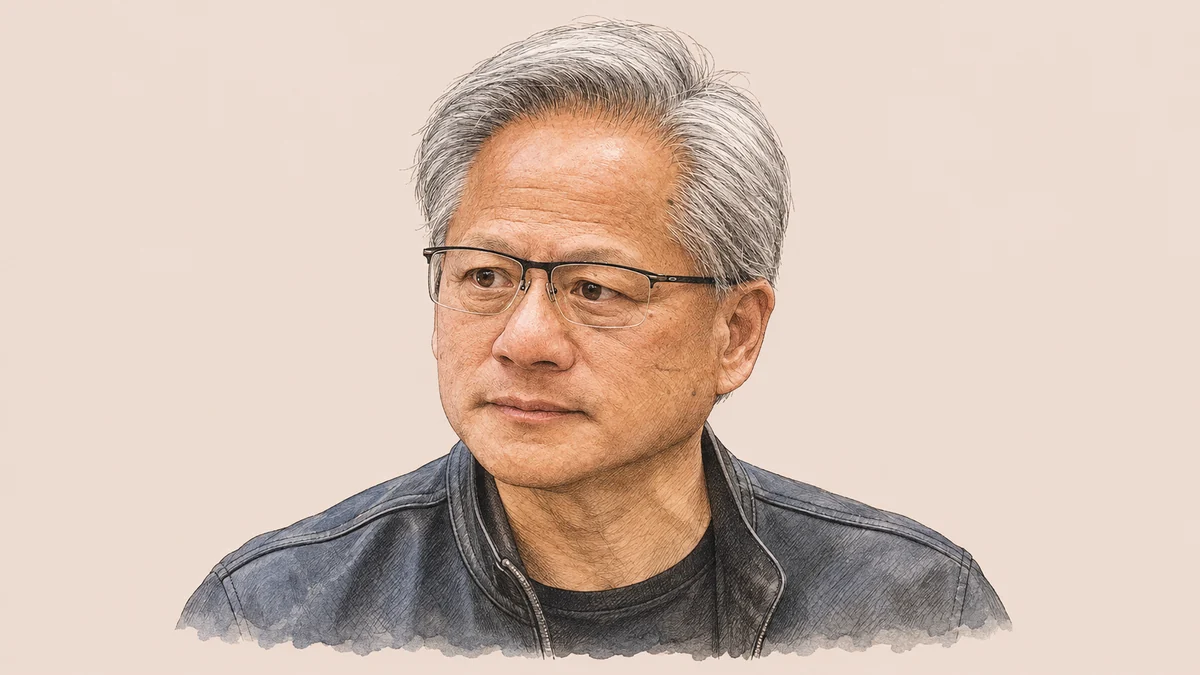
Jensen Huang co-founded Nvidia, the chipmaker he led for more than three decades. An electrical engineer by training, he helped steer the company from video-game graphics into computing hardware used to train artificial intelligence.
He founded Nvidia with Chris Malachowsky and Curtis Priem in 1993, betting on better three-dimensional graphics.
A video game gives a computer a relentless drawing assignment: work out where objects belong, how light falls across them and what color each part of the screen should be. Then do it again as the player moves.
Building chips for that work eventually opened a path into AI. Getting there took some expensive lessons about what software developers needed.
The Early Bet That Failed
Huang was born in Tainan, Taiwan, in 1963 and immigrated to the United States at nine. He studied electrical engineering at Oregon State University, graduating in 1984, and earned a Stanford master's degree in 1992 while working full time.
Before Nvidia, he designed microprocessors at AMD and later directed a business unit at LSI Logic. The Computer History Museum's account of his career traces how that engineering background developed into leadership of a computing company.
Nvidia's first product, NV1, arrived in May 1995. It combined graphics, video and audio using a proprietary approach. But the industry was adopting Direct3D and OpenGL, shared ways for software to request graphics work. Nvidia had chosen a different direction.
According to the company's 1999 stock-offering filing, NV1 sales declined. Nvidia discontinued work on NV1 and its planned successor, NV2, and shifted to a product compatible with Direct3D.
That chip, RIVA128, began shipping commercially in August 1997. Sales grew sharply after its arrival, helping the company recover from losses that had continued through the first three quarters of that year.
Huang and his colleagues had found a way forward by fitting their hardware to the software people wanted to run. Years later, they would invest in software to help people find new uses for the hardware.
More Than Drawing Pictures
In 1999, Nvidia introduced the GeForce 256, a graphics processing unit, or GPU. It handled calculations for transforming three-dimensional objects and lighting them, taking over work from the computer's central processing unit, or CPU.
A CPU handles the varied work of running a computer. A GPU devotes substantial resources to performing many similar calculations at once. Both can work in parallel, but they're organized differently.
That difference gave graphics chips a possible job beyond games. Training a neural network involves repeated arithmetic on large collections of numbers. A neural network is a set of connected calculations whose adjustable values change as it learns from examples.
Much of that arithmetic could suit a GPU, provided programmers could organize the work for the chip. Getting information into and out of it efficiently was part of the problem, too.
Huang's company had useful machinery. It needed to give developers a practical way to put it to work.
CUDA Opened the Door
Nvidia unveiled CUDA in 2006. The programming platform let developers use Nvidia GPUs for calculations beyond drawing images.
A scientist might have a problem well suited to parallel calculations but still need a way to express it in code the chip could run. CUDA supplied a programming model, a compiler to translate code and development tools for doing the job.
At a Stanford talk in November 2006, Nvidia's Ian Buck described GPU computing for scientific work, data analysis and product design, as well as game physics. Engineers such as Buck were making the broader computing platform usable, with Huang backing it as Nvidia's leader.
CUDA gave developers somewhere to accumulate working code, tools and experience. For a research team, the ability to build on that work could matter as much as the chip itself. Nvidia was developing a relationship with programmers whose interests extended well beyond gaming.
Two Gaming GPUs and a Research Result
In 2012, Alex Krizhevsky, Ilya Sutskever and Geoffrey Hinton trained a large image-recognition network at the University of Toronto using two Nvidia GTX 580 GPUs.
Their AlexNet paper described training that took about five to six days. A version of the system won that year's ImageNet competition, showing researchers how well deep neural networks could work with enough examples and suitable computing power.
The examples came from ImageNet, the picture collection developed by Fei-Fei Li and collaborators. The Toronto team combined those images with its own learning methods and software. Nvidia's gaming chips did the repeated calculations the experiment needed.
The result connected Huang's business to a growing research field. A company built around drawing images was supplying hardware that could help computers recognize them.
Building a Whole AI Computer
Training a model changes its numerical settings. Once trained, it can use those settings to process new inputs, a stage called inference. An image recognizer might learn from a collection of labeled photographs, then apply what it learned to a new picture.
Running the finished model brings its own demands. How quickly does it respond? How much memory does it need? How many requests can the system handle? Engineers have to fit the processors, memory and software to the work.
Nvidia increasingly supplied complete systems as well as individual components. In 2016, Huang delivered the first DGX-1 to OpenAI. As Nvidia's retrospective describes it, the machine brought together eight GPUs for AI work.
That was a different product from a graphics card installed in a gaming computer. It packaged computing resources for research teams, making AI development a purpose of the machine from the start.
Three Decades in Charge
Huang led Nvidia for more than three decades. A November 2026 SEC filing records that the board accepted his resignation as president, chief executive and director on November 11, effective immediately. Nvidia announced the change on November 12, with chief financial officer Colette Kress becoming interim CEO.
The two GTX 580s in the Toronto experiment had come from a gaming-hardware company. By the time Huang left, Nvidia had built whole computing systems for the researchers who had found another use for its chips.
Ilya Sutskever: From AlexNet to Safe Superintelligence
Fei-Fei Li: Why Millions of Labeled Pictures Changed AI

Geoffrey Hinton Helped Build Modern AI. Now He's Worried.

QUOTE:
"Amateurs hack systems, professionals hack people."