What AMD Makes for Gaming PCs, Laptops and AI Servers
- What’s in a Ryzen desktop processor?
- What the Ryzen 7 9850X3D Changes in a Game
- Radeon gaming cards and what their numbers buy
- Two Radeons Go Head to Head in More Than 50 Games
- What Ryzen AI does in a laptop
- How Much Memory Does a Local AI Model Need?
- Threadripper and Radeon PRO in an animation studio
- Programmable chips for cameras
- A Smart Camera Built With a Kria Kit
- EPYC and Instinct in the same server
- What Goes Inside AMD’s Helios Rack
- Running a Language Model on an Instinct MI300X
- AMD’s chips in brief
Advanced Micro Devices (AMD) designs two parts you might bring home to play one racing game. One box says Ryzen 7 9850X3D. Inside is a central processing unit (CPU) that runs the game rules, right down to whether your car spins out in a puddle. The other box says Radeon RX 9070 XT. It holds a graphics card whose graphics processing unit (GPU) draws the spray on your windshield.
Sony put both kinds of hardware together in one custom chip for the original PlayStation 5. A cloud company can buy an entire rack of AMD chips to run an artificial intelligence (AI) service, then rent out computing time by the hour.
What’s in a Ryzen desktop processor?
The CPU runs your operating system and the instructions in your apps. Its cores can work on separate tasks. Animation software, for instance, can use several cores at once to work on different frames of a film.
In 2017, $499 bought AMD’s eight-core Ryzen 7. Two years later, the same money bought twelve cores. These are AMD’s suggested U.S. launch prices for one desktop CPU.
| Ryzen desktop processor | First on sale | CPU cores | U.S. launch price |
|---|---|---|---|
| Ryzen 7 1800X | March 2, 2017 | 8 | $499 |
| Ryzen 7 2700X | April 19, 2018 | 8 | $329 |
| Ryzen 5 3600 and Ryzen 9 3900X | July 7, 2019 | 6 and 12 | $199 and $499 |
| Ryzen 5 5600X and Ryzen 9 5950X | November 5, 2020 | 6 and 16 | $299 and $799 |
| Ryzen 5 7600X and Ryzen 9 7950X | September 27, 2022 | 6 and 16 | $299 and $699 |
| Ryzen 7 9800X3D | November 7, 2024 | 8 | $479 |
| Ryzen 7 9850X3D | January 29, 2026 | 8 | $499 |
| Ryzen 9 9950X3D2 Dual Edition | April 22, 2026 | 16 | $899 |
The 7 in Ryzen 7 tells you the chip’s place in AMD’s lineup. Zen is AMD’s name for the design of the cores inside. The 1800X used the original Zen design. The 9800X3D uses Zen 5.
Even the final letter can matter. The Ryzen 5 7600 and 7600X both have six cores. The 7600X can run its cores at a higher speed, and the plain 7600 comes with a cooler in the box. That’s what the X changes for this particular pair.
For an upgrade, first check the CPU socket on your PC’s main circuit board, the motherboard. The six-core 5600X fits an AM4 socket. The six-core 7600X needs an AM5 board and newer DDR5 memory. Both launched at $299. If you own the AM4 board, switching to the 7600X means buying more than a processor.
Why gamers pay for X3D
A racing game has to track every car’s speed and position, turn after turn. Cache is a small store of very fast memory close to the CPU cores. If the CPU finds the data it needs there, it saves a slower trip to the PC’s main memory.
X3D means AMD stacked extra cache on the processor. The eight-core 9800X3D has 64 megabytes (MB) of that extra memory. The 16-core Dual Edition houses two separate pieces of silicon with CPU cores on them. AMD gave each piece its own stack, bringing the chip’s largest layer of cache, called L3, to 192 MB.
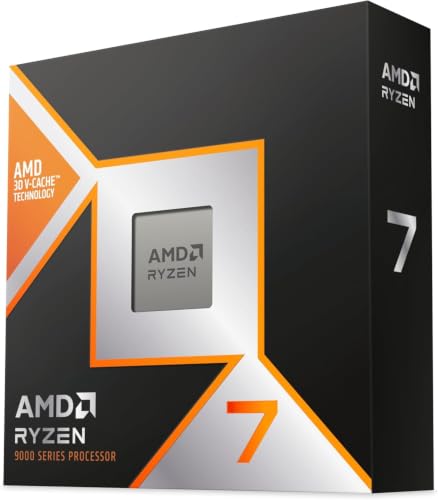
- This eight-core chip has extra memory stacked close to the cores so a game can reach frequently used data sooner.
- It fits an AM5 desktop motherboard. AMD sells this boxed model without a CPU cooler.
Would twice as many cores make a game run twice as fast? Tom’s Hardware compared 17 games, including F1 24, in results updated November 20, 2026. The testers used the same fast GeForce RTX 5090 graphics card at 1080p (1,920 by 1,080 pixels) so the CPUs had a chance to show their differences. They gave the fastest chip 100 points.
Relative gaming performance at 1080p. The eight-core 9850X3D sets the 100-point mark.
- Ryzen 7 9850X3D
- 100
- Ryzen 7 9800X3D
- 97.0
- Ryzen 9 9950X
- 76.9
Figures from the CPU gaming tests by Tom’s Hardware.
The older, eight-core 9800X3D delivered about 97% of the leader’s frame rate across those games. The 16-core 9950X, which lacks the stacked cache, managed about 77%. Doubling the core count didn’t win this race. On November 29, AMD’s U.S. store listed the winning 9850X3D at $454. It was out of stock.
What the Ryzen 7 9850X3D Changes in a Game
Radeon gaming cards and what their numbers buy
AMD bought graphics specialist ATI in 2006. Today it can build graphics into a processor, as it did for Microsoft’s Xbox Series X. For desktop PCs it also designs Radeon RX graphics cards. A card plugs into the motherboard and brings its own video memory to hold things like the paintwork on a race car.
RX 6000, 7000 and 9000 mark three families of cards built around graphics designs AMD calls RDNA 2, 3 and 4. Then there are the letters. The RX 9070 XT has more processing units than the plain RX 9070 from the same launch. An XT badge alone tells you little about a card from a different year.
| Radeon gaming card | Went on sale in the U.S. | Video memory | U.S. launch price per card |
|---|---|---|---|
| RX 6800 and 6800 XT | November 18, 2020 | 16 GB each | $579 and $649 |
| RX 6750 XT and 6950 XT | May 10, 2022 | 12 GB and 16 GB | $549 and $1,099 |
| RX 7900 XT and 7900 XTX | December 13, 2022 | 20 GB and 24 GB | $899 and $999 |
| RX 7600 | May 25, 2023 | 8 GB | $269 |
| RX 7700 XT and 7800 XT | September 6, 2023 | 12 GB and 16 GB | $449 and $499 |
| RX 9070 and 9070 XT | March 6, 2025 | 16 GB each | $549 and $599 |
| RX 9060 XT | June 5, 2025 | 8 GB or 16 GB | $299 or $349 |
| RX 9070 GRE | June 2, 2026, global release | 12 GB | $549 |
An extra $50 bought two very different things here. On the 9060 XT, it doubled the amount of video memory from 8 to 16 gigabytes (GB). On the 9070, it bought a faster graphics processor with the same 16 GB. And the 9070 GRE arrived a year later with less memory than the plain 9070, at the same original U.S. price.

- PowerColor builds this desktop graphics card around AMD’s RX 9070 XT, one of the three models in the 4K comparison.
- Its 16 GB of video memory holds textures and other data the graphics chip needs to draw a game.
Which Radeon is faster at 4K?
A frame is one complete picture. At 60 frames per second (fps), you get a new one roughly every sixtieth of a second. At native 4K, the GPU draws each one at the screen’s full 3,840 by 2,160 pixels. Some games can start with a smaller picture and enlarge it. Others can also fill the gaps with software-generated frames. Both can raise the frame rate you see.
Tom’s Hardware left both off in its GPU comparison updated November 18, 2026. The testers ran each card in the same Ryzen 7 9800X3D PC using high or ultra detail, depending on the game. Eleven games used standard graphics, which map shapes onto the screen. A second group of eight used ray tracing, which follows paths of light to draw effects like the reflection of a car in a shop window.
Frames per second. Longer bars mean smoother motion in this set of games.
Standard graphics · 11 games
- RX 6950 XT
- 48.3
- RX 7900 XTX
- 70.6
- RX 9070 XT
- 65.8
Ray tracing · 8 games
- RX 6950 XT
- 15.6
- RX 7900 XTX
- 27.3
- RX 9070 XT
- 30.1
Figures from the November 2026 GPU tests by Tom’s Hardware.
The 7900 XTX drew about 7% more frames per second than the 9070 XT in the standard games. Switch to the ray-tracing group and the 9070 XT pulled about 10% ahead of the 7900 XTX. AMD redesigned the hardware that traces rays for the 9000 series. A newer card can gain ground on that job even when the older card leads in ordinary graphics.
Each bar is a geometric average, which gives each game equal weight when comparing relative speeds. Only four games appear in both groups. To see what turning on reflections costs you in one particular game, you’d need to test that game both ways.
At the lower resolution of 1440p (2,560 by 1,440 pixels), the 16 GB 9060 XT averaged 67.3 fps with standard graphics. The 8 GB version reached 62.5, and the 9070 XT reached 116.5 in the same 1440p tests. Both versions of the cheaper 9060 XT cleared 60 fps on average. Doubling video memory bought about 8% more frames per second in these tests.
Two Radeons Go Head to Head in More Than 50 Games
What Ryzen AI does in a laptop
On a video call, the CPU runs the app, and the built-in Radeon GPU can draw the picture. A third part, the neural processing unit (NPU), does certain AI calculations using little power. It can spend the whole meeting blurring the laundry behind you. Windows Studio Effects uses an NPU for camera effects like this on supported computers.
AMD introduced its Ryzen AI 400 laptop chips in January 2026. The Ryzen AI 9 HX 475 combines twelve CPU cores, Radeon 890M graphics and an NPU rated at up to 60 trillion operations per second, or 60 TOPS. That’s a peak count of certain math operations. For an AI app, first check which chip it uses. A faster NPU won’t speed up a chatbot that sends its work to the GPU.
How a little desktop can hold a big AI model
A chatbot needs memory for the numbers its model learned during training. The Ryzen AI Max+ 395 pairs sixteen CPU cores with built-in Radeon 8060S graphics. Both use the same pool of shared memory. That can give the GPU room to hold a model too big for a separate 16 GB graphics card. The operating system and your other apps need a share, too.
ASUS put the chip in a ROG Flow Z13 tablet with 32 GB of memory and a 1 TB drive. The drive can keep model files even with the power off. The 32 GB is what the computer works with when you open one.

- This 13.4-inch computer pairs AMD’s Ryzen AI Max+ 395 with 32 GB of memory shared by its processor and graphics.
- The 1 TB drive stores files. It serves a different purpose from the 32 GB a running program can use.
In February 2025, Framework announced a $1,999 DIY desktop with the Max+ 395 and 128 GB of memory. Its smaller eight-core Max 385 version with 32 GB started at $1,099. Buyers still needed storage and an operating system.
AMD pushed the idea further in October 2026 with the Ryzen AI Halo, a developer PC. The Max+ PRO 495 version supports 192 GB of shared memory. AMD says up to 160 GB can go to graphics. If you’re running a model on your own computer, that figure helps tell you whether it will fit. How soon you get a reply also depends on the model and software.
How Much Memory Does a Local AI Model Need?
Threadripper and Radeon PRO in an animation studio
A workstation is a PC built for demanding professional software. An artist might need a graphics card with room for a 3D set and all its characters. The studio might also use the CPU to draw a batch of finished frames overnight.
Ryzen Threadripper is AMD’s workstation CPU line. On July 31, 2025, the 24-core 9960X went on sale at $1,499, the 32-core 9970X at $2,499, and the 64-core 9980X at $4,999. Those are prices for one processor. Each extra core can help if the studio’s software can divide the work.
The 96-core Threadripper PRO 9995WX launched at $11,699 eight days earlier, on July 23. On a matching PRO motherboard it has eight channels for moving data to and from system memory. The 9980X on a standard workstation board has four. Those extra paths help when dozens of cores need data at once.
For graphics, AMD’s Radeon AI PRO R9700 has 32 GB of its own memory, twice as much as the gaming RX 9070 XT. A developer can use that extra room to fit a larger model on one card. PC makers began offering R9700 workstations on July 23, 2025. As of October 1, AMD listed the card alone at a suggested price of $1,299.

- This workstation graphics card has 32 GB of dedicated memory for jobs such as running an AI model on your own computer.
- That’s twice the memory on the 16 GB Radeon RX 9070 XT gaming card.
Programmable chips for cameras
A factory camera might have to spot objects as they pass. A field-programmable gate array (FPGA) lets an engineer arrange a chip’s circuits to handle a specific job like that. If the job changes, the engineer can change the circuits again. AMD took on this line of chips when it bought Xilinx in 2022.
Xilinx introduced the Kria KV260 Vision AI Starter Kit in April 2021. Engineers can plug in a camera and try out a design. On November 29, 2026, AMD listed the kit at $249, with the power supply sold separately. For a finished camera, the manufacturer can buy the compact K26 module to build into its own equipment.
A Smart Camera Built With a Kria Kit
EPYC and Instinct in the same server
A hospital might use a server to track appointments. A cloud company might run several customers’ computers in software on a single machine. EPYC is AMD’s line of CPUs for jobs like those.

- The authors explain what it takes to make a building full of computers work as one machine.
- They follow the costs beyond the chips, including the network, the electricity and the cooling.
AMD quoted these U.S. launch prices per processor in an order of 1,000. A server maker still has to add the board, memory, storage, power and cooling.
| EPYC server processor | Generation and availability | Cores per CPU | Price per CPU at 1,000 units |
|---|---|---|---|
| EPYC 9654 | Fourth generation, Genoa, November 10, 2022 | 96 | $11,805 |
| EPYC 9965 | Fifth generation, Turin, October 10, 2024 | 192 | $14,813 |
| EPYC 9996 | Sixth generation, Venice, broad system availability November 10, 2026 | 256 | $14,904 |
What happens when you ask a chatbot to shorten a letter?
In an AMD Helios system, an EPYC CPU can run the software that takes your request. AMD’s Instinct GPUs do the many calculations that help the model choose the next piece of text. It makes one choice after another until you have your shorter letter. Using a model’s learned patterns to produce an answer is called inference.
Helios packs 72 Instinct GPUs into one rack, the frame that holds the computing gear. If a model is spread across several chips, the chips must share their results. Fast links carry those numbers inside the rack. AMD’s Pensando networking hardware can carry data to other machines. AMD’s ROCm software gives developers ready-made tools for the math their models run on those GPUs.
On July 23, 2026, AMD said Helios racks with MI455X GPUs and sixth-generation EPYC CPUs were in production. At its November earnings call, AMD reported that it had shipped MI455X chips in volume during the third quarter. Microsoft and Oracle were among the customers with their first racks online. On November 10, AMD announced that server makers were shipping the new EPYC systems more broadly. Those buyers help explain how AMD makes its money.
What Goes Inside AMD’s Helios Rack
How much can fit on one Instinct GPU?
Instinct keeps the numbers a model learned close to the GPU in high-bandwidth memory. Its capacity tells you how much data fits there. Its bandwidth tells you how much of that data the GPU can move in a second.
| Instinct accelerator | AMD introduction | Memory on one GPU | Peak memory bandwidth per GPU |
|---|---|---|---|
| MI300X | December 6, 2023 | 192 GB | 5.3 terabytes/s |
| MI325X | October 10, 2024 | 256 GB | 6 terabytes/s |
| MI350X and MI355X | June 12, 2025 | 288 GB each | 8 terabytes/s each |
| MI455X | July 23, 2026 | 432 GB | 23.3 terabytes/s |
The MI350X and MI355X have the same memory capacity and peak bandwidth. What happens when eight of each tackle exactly the same job?
How long eight GPUs take to train a model
In November 2026, AMD submitted two eight-GPU systems to MLPerf, a set of tests run by MLCommons. The task was to fine-tune an existing AI model, Llama 2 70B, to summarize government reports. This method adjusts a small set of extra numbers. The model keeps the numbers it learned in its original training.
MLCommons measures how well the model predicts the text in a reference summary. The clock stops when the model’s error score falls to the same target of 0.925.
Minutes to reach the same target on the Llama 2 70B test. Shorter is faster.
- 8 × MI350X
- 8.72 min
- 8 × MI355X
- 6.98 min
Figures from AMD’s MLPerf Training 6.1 results.
The eight MI350X GPUs took about 8 minutes 43 seconds. The eight MI355X GPUs took 6 minutes 59 seconds, about 20% less time. Those are AMD’s measured times for the complete systems.

- Sebastian Raschka walks Python programmers through building a small language model.
- You can train it on text and then watch it generate new text, one piece at a time.
How much text can one GPU serve?
Suppose a crowd of people type questions at once. Each person cares how fast one reply appears. The service also cares how much text it can send across everyone’s replies.
AMD tested this in July 2026 and published the details in October. One MI455X in a pre-release Helios system ran the DeepSeek-V4-Flash model. One MI355X ran the same model with the same serving software. Each request used 1,024 tokens of input and 1,024 of output. A token is a piece of text. It can be a whole word or just part of one.
AMD varied the number of requests running at once. At a target of 30 output tokens per second per person, the MI455X produced 3.70 times as much text per second across all users as the MI355X. For the person reading one reply, the speed target stayed at 30 tokens per second.
What an hour of Instinct computing costs
In November 2026, DigitalOcean listed a machine with one MI300X at $2.59 an hour. A machine with eight MI300X GPUs was $20.72 an hour. A machine with eight of the newer MI325X GPUs was $30.40 an hour.
Running a Language Model on an Instinct MI300X
Oracle’s November 1 price list used a different unit for its dedicated servers, charging $8.60 per MI355X GPU per hour. Eight GPUs for one hour would account for $68.80 in GPU charges. Oracle’s list gave no MI455X rate. A team looking to own a Helios rack would need a purchase quote.
AMD’s chips in brief
In a gaming PC, a Ryzen processor runs the game and Radeon graphics draw each frame. A laptop can do both jobs with one chip. A film studio might choose a Threadripper processor so it can put dozens of cores to work drawing different frames of the same scene overnight.
In a data center, an EPYC processor can run the software that takes your question. Instinct chips do the math that helps a chatbot write the reply. For a service renting the machine by the hour, a faster chip can mean more people get answers at once, even if the words on your screen arrive at the same pace.
Back at the racetrack, suppose you want to see the cars reflected in the wet asphalt at 60 fps in native 4K. Of the three Radeons tested, the RX 9070 XT drew ray-traced scenes the fastest. It still averaged just 30.1 fps in that group, about half your target. Before buying that card for wet laps at 60 fps, check the result for the racing game you actually play.
Why AMD’s Sales Jumped 45% (November 2026)
What Nvidia Makes, From Graphics Cards to AI Servers
Can You Run AI on Your Own Computer?
QUOTE:
"Amateurs hack systems, professionals hack people."