How SD-WAN Chooses a Path for Your Traffic
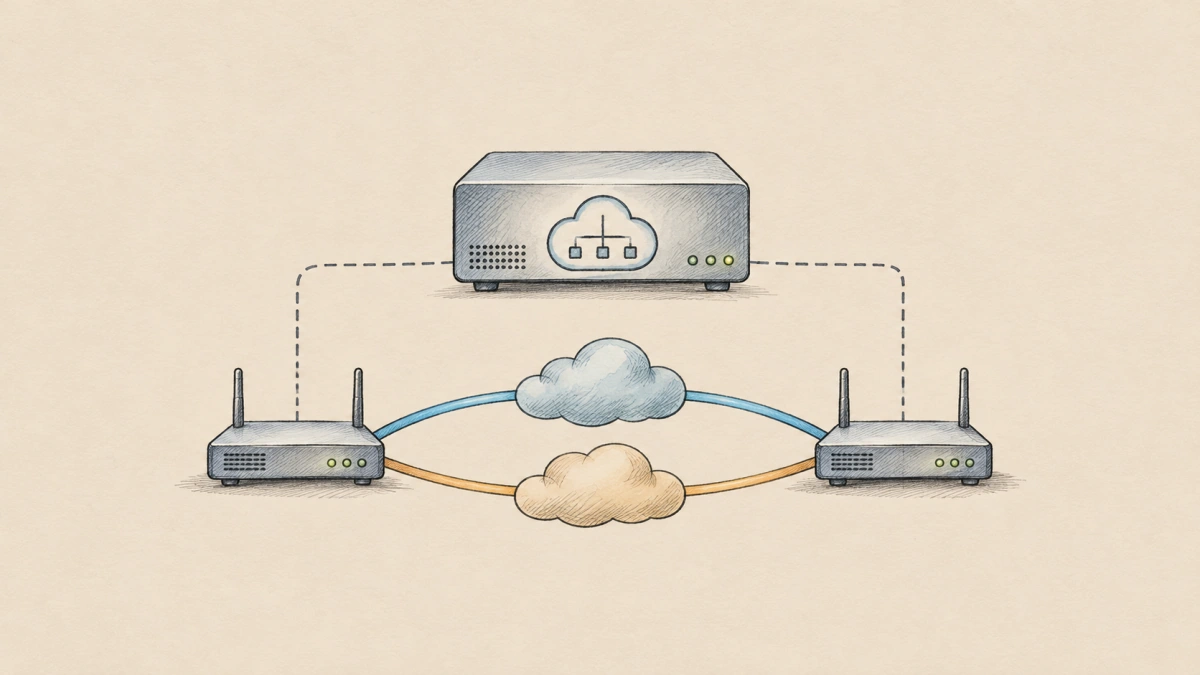
A wide area network connects computers across locations, such as a company's branch offices. SD-WAN, short for software-defined wide area network, uses software rules to control how traffic travels over those connections. Different applications can use different paths, even when they share the same office network.
The rules are called policies. They express decisions about which traffic should use which available connection and what conditions should influence that choice.
The underlying connections still carry the data. They may include internet access or private network services. SD-WAN adds a way to manage how they're used; it doesn't manufacture extra capacity in the wires or radio links.
Why the Internet's Road Map Keeps Breaking
One branch, two kinds of work
Suppose an office has two available network connections. An employee is making a voice call while another application transfers a large file.
The call benefits from low delay because the people speaking need to hear each other promptly. The file transfer may be able to tolerate a path with more delay. A policy can express those different needs rather than treating both applications as identical traffic.
Network data travels in packets, small units of data with information about where they're going. SD-WAN can classify related packets as an application flow and apply a policy to that flow. Measured conditions on the available paths can help determine which one it uses.
The MEF 70.2 industry specification for SD-WAN services describes this relationship among application flows, policies and underlying connectivity. It supplies a service model, rather than a promise that every commercial product has the same features.
In the office example, a useful outcome might be keeping the call on a suitable path while sending the transfer over another. Whether that improves the experience depends on the actual links and the rules. If neither path can carry the required traffic well, the policy has no excellent option to choose.
Managing the network isn't carrying every packet
SD-WAN is often explained through a central management screen. That can leave the impression that all traffic must travel through the computer displaying the screen.
Cisco's documented implementation separates those jobs. A management system configures and monitors the network; other components distribute routing and policy information; edge devices at network boundaries forward the user's traffic.
The edge devices carry traffic through tunnels, logical connections built across the underlying network. Cisco's Catalyst SD-WAN overview describes that division. Its specific component names aren't a requirement for every SD-WAN system.
You may hear the logical network called an overlay, while the connections carrying it are the underlay. The two are different views of the same journey: the managed path the organization uses, and the actual connectivity that transports its packets.

- Keep the internet up by connecting a second provider as backup.
- Reach your home network securely from anywhere with built-in VPN support.
- Filter and block unwanted traffic with a real firewall.
A path policy has a narrower job than a security guarantee
SD-WAN services can include encryption between edge devices, making traffic unreadable to someone without the required secret data values, or keys. The MEF model treats this as a configurable capability. The protected part of the journey depends on the service and its configuration.
Other protections, such as detecting harmful content, need to be checked separately. The SD-WAN label alone doesn't establish that they're included, any more than it establishes that a bill will fall or an application will always take the fastest route.
Multihoming: Giving Network Traffic Another Way Out
Dynamic Routing Protocols: How Networks Find Another Way
Network Resilience: Three Ways to Call, One Way to Fail
QUOTE:
"Amateurs hack systems, professionals hack people."