Andrew Ng Opened the AI Classroom to the World
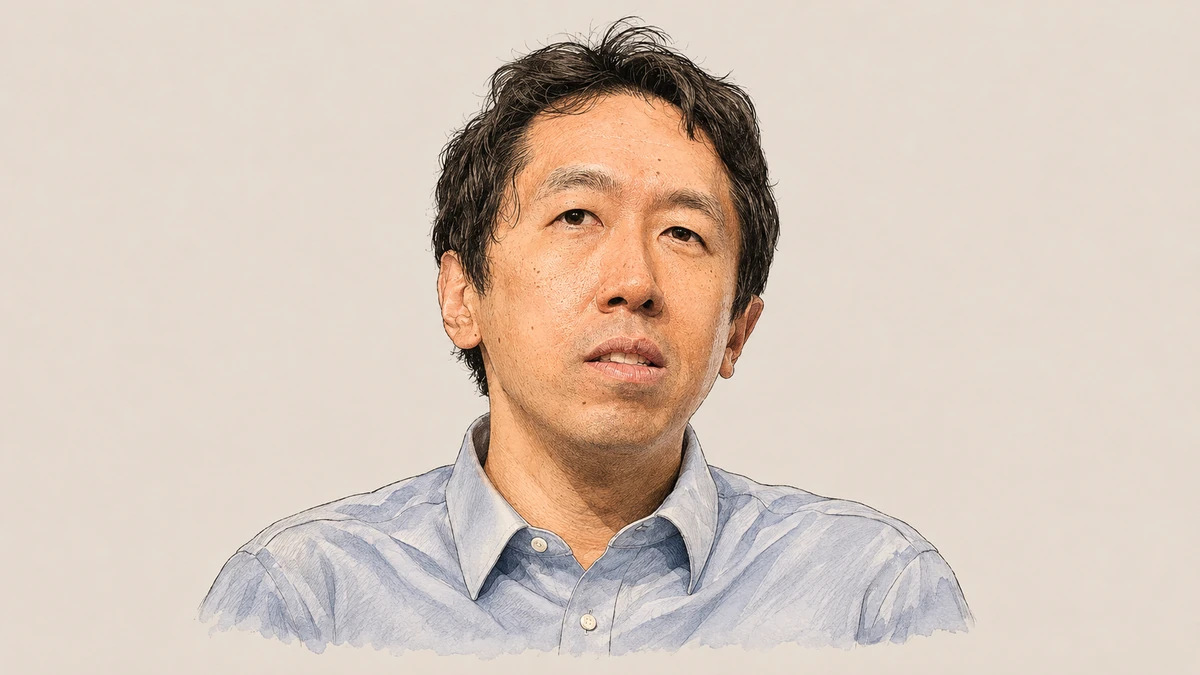
Andrew Ng is a computer scientist and teacher who helped launch the Google Brain AI research group. He also co-founded Coursera, an online learning platform. His research and courses focus on machine learning: teaching computers to learn from examples instead of writing a separate rule for every case.
In 2011, more than 100,000 people enrolled in his online course on the subject. His course history traces the path from that Stanford class to Coursera and DeepLearning.AI, the education company he later founded.
Behind the lessons were years of practical research. Before bringing machine learning to a worldwide classroom, Ng had helped put it to work in an aircraft.
A Helicopter Learns From a Pilot
Ng earned degrees at Carnegie Mellon, MIT and the University of California, Berkeley before his work at Stanford. There, one research project gave learning from examples an unusually visible result: a remote-controlled helicopter performing aerobatics on its own.
The researchers drew on demonstrations from expert pilots, including Garett Oku. The computer's task was to infer the intended maneuver from those flights and learn a model that could help it control the aircraft.
Simply copying a pilot's movements wouldn't have been enough. Demonstrations contain small mistakes and variations. The system needed to work out the flight path the pilot was trying to follow, instead of preserving every wobble.
Adam Coates, Pieter Abbeel and Ng described the approach in their 2008 paper, “Learning for Control from Multiple Demonstrations.” The project's recorded flights included loops and coordinated sequences performed autonomously in the team's experimental setup.
The pilot supplied skilled examples; the researchers worked out how to learn from them. The helicopter gave the team a physical test of whether its method worked.
Finding a Cat Without a Cat Label
Ng later helped launch Google Brain, a research effort exploring what larger neural networks could learn. Neural networks contain connected layers of calculations, with numerical settings that change during training.
In 2012, Ng and Jeff Dean described an experiment using still frames from YouTube videos. The training images weren't labeled with the objects they contained. Even so, part of the network became responsive to pictures of cats.
The team, whose paper was led by Quoc Le, spread its calculations across 16,000 calculation units, called cores, inside general-purpose computer processors. Useful visual features emerged from the data without someone first writing “cat” beneath each training picture.
In supervised learning, an example comes paired with a desired answer. This stage of Google's experiment instead sought patterns without those category labels, an approach called unsupervised learning.
A unit responding to cat pictures was still a long way from a person's knowledge of cats. The researchers tested which images it responded to and how useful the learned features were. They had demonstrated another way for computers to find patterns worth using.
Opening the Classroom
Ng's teaching developed alongside that research. The online Stanford courses that began in fall 2011 gave learners more to do than watch a lecture.
A contemporary Stanford account describes short video segments with quizzes and immediate feedback. Learners could revisit trouble spots and discuss the material online. Successful participants received a statement of accomplishment, rather than Stanford academic credit.
A wrong answer could point a student toward the part of a lesson they needed to revisit. Exercises gave them a way to put an explanation to work, even when they were studying far from the instructor.
In 2012, Ng and fellow Stanford professor Daphne Koller co-founded Coursera. The platform extended university teaching beyond a single class or instructor, making courses available to people outside the institutions' own campuses.
Turning Speech Into Text
Baidu appointed Ng chief scientist in 2014, overseeing research across Beijing and Silicon Valley. Speech recognition offered a practical problem for his teams: converting sound into written words despite changes in speakers and recording conditions.
In the 2014 Deep Speech paper, Awni Hannun and a team including Coates and Ng described training a neural network to map audio to text. They used multiple graphics processing units, chips suited to many calculations at once, and varied training examples. Their tests included recordings with background noise.
The approach was called “end to end.” Engineers trained a network to learn the relationship between the input audio and the desired text, reducing the need to hand-design each intermediate stage of speech processing.
From helicopter maneuvers to written transcripts, Ng's teams had worked on very different outputs. Each project depended on defining the task, providing suitable examples and checking the result.
When to Teach the Math
Ng later left Baidu and founded DeepLearning.AI in 2017. The organization develops AI education with teaching teams and partner instructors, including technical courses and introductions for people who don't plan to become machine-learning engineers.
One revealing decision concerned the order of a lesson. In a 2022 account of course planning, the teaching staff described how Ng and the team approached mathematics. They introduced concepts just before students needed them, instead of starting with a large review detached from the task ahead.
A learner could meet the mathematics while solving a problem that gave it a purpose. The course retained the technical explanation while changing the route into it.
Ng continues to combine education with company-building. He is an adjunct professor at Stanford, the founder of DeepLearning.AI and executive chairman of LandingAI, among other roles listed in his current biography.
His practical advice often returns to the examples used in machine learning. In a 2021 essay on data quality, he argued that teams can gain more by improving their data than by repeatedly changing their models.
His questions were concrete. Do labels agree? Does the collection cover the cases that matter? Does feedback from real use find its way back into development?
Speech provides a simple example. If transcribers represent the same ambiguous sound in different ways, their labels give the model conflicting targets. Before choosing a more elaborate learning method, the team has to settle what a good answer should be.
Andrej Karpathy Takes AI Apart So You Can Understand It
Fei-Fei Li: Why Millions of Labeled Pictures Changed AI
Machine Learning and Evolution: When 98 Percent Is a Failure
QUOTE:
"Amateurs hack systems, professionals hack people."