Andrej Karpathy Takes AI Apart So You Can Understand It
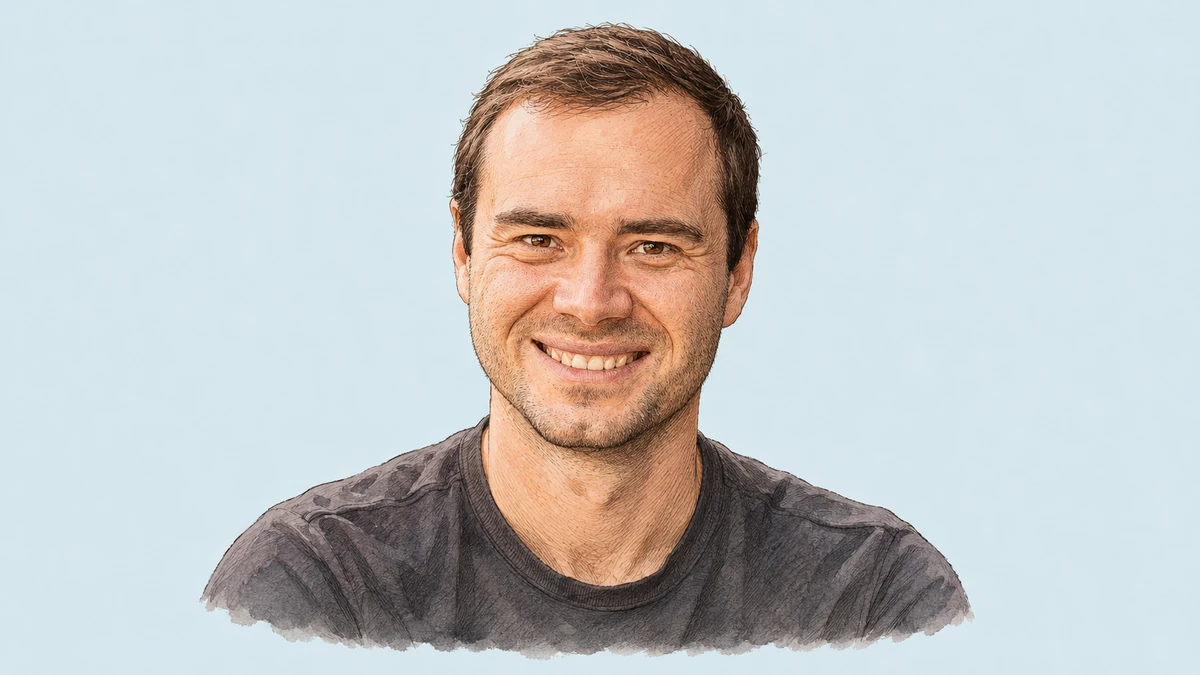
Andrej Karpathy is an AI researcher and teacher who helped build learning systems at OpenAI and Tesla. His public courses and programming projects explain the ideas behind such systems, giving learners code they can inspect, change and run themselves.
One example is MicroGPT, which he released in February 2026. It's a tiny language model: a program that learns patterns in text and uses them to predict what comes next. In this case, it learns from names and generates new ones, with the whole process fitting into roughly 200 lines of Python code.
Its 4,192 adjustable numerical settings are small enough for a determined learner to follow from beginning to end. That teaching project draws on a career spent building and explaining much larger learning systems.
Learning to Connect Pictures and Words
Karpathy studied computer science and physics at the University of Toronto from 2005 to 2009, with a mathematics minor. In his account of those years, he identifies Geoffrey Hinton's course and reading group as an introduction to deep learning.
Deep learning uses neural networks with multiple layers of calculations. During training, those layers adjust their numerical settings to improve at a task. Researchers arrange the examples, calculations and feedback so the system can do something useful with material it hasn't already seen.
At the University of British Columbia, Karpathy worked with Michiel van de Panne on controllers for simulated figures. He then moved to Stanford, where Fei-Fei Li became his doctoral adviser.
His research explored the gap between recognizing objects and describing a picture. A system that returns the label “dog” has solved one problem. Producing a sentence about the scene requires connecting objects, attributes and relationships with language.
In work published at CVPR in 2015, Karpathy and Li paired parts of images with parts of sentences, then used those connections to generate descriptions. His 2016 Stanford dissertation, Connecting Images and Natural Language, developed that research further.
Alongside the experiments came another job: explaining how the systems worked to students who would build their own.
A Class Where Students Had to Build
In winter 2015, Li and Karpathy taught Stanford's CS231n, a course on neural networks for computer vision. Its archived materials show a class built around practice. Students wrote, trained and debugged networks, working through the calculations that turned a wrong answer into an adjustment.
One of those calculations is backpropagation. A training process first measures how far a network's answer is from the desired result. Backpropagation traces that error backward through the network, calculating how changes to its adjustable values would affect the error. Another procedure uses that information to update the values.
Writing the code gives a student a chance to follow each step, including the point where a mistake makes the result go wrong.
Karpathy also took his experiments outside the classroom. His May 2015 essay, “The Unreasonable Effectiveness of Recurrent Neural Networks,” used networks designed to process sequences. Predicting another character, then another, could produce recognizable patterns of text.
Readers could inspect the output and the code that made it. That combination would keep returning in his public teaching.
Taking Networks Into Cars
Karpathy became a founding research scientist at OpenAI in 2015. In 2017, he moved to Tesla as director of AI, leading the computer-vision team for Autopilot, its driver-assistance system, until 2022.
His responsibilities covered labeling data, training networks and getting them to run on the company's inference hardware. Inference is what happens after training: the system uses its learned numerical settings to process a new input. His team worked on turning camera images into information for the larger driving system.
That job involved more than choosing a network's mathematical design. The team needed suitable examples, reliable labels, useful tests and a way to run the result within the hardware's limits.
Karpathy described this kind of engineering in his 2017 essay “Software 2.0.” Instead of writing every rule that determines an answer, engineers can build a process that learns from examples. Choosing the data and deciding what counts as improvement become central parts of programming.
He returned to OpenAI in 2023–2024. This time, his own career record describes building a team working on training stages and synthetic data: examples generated by models for use in further development.
Making the Small Pieces Visible
Karpathy's educational projects let learners examine the machinery without first navigating the huge codebase of an industrial system.
One of them, micrograd, follows arithmetic operations and calculates how changes to individual inputs affect the result. It supplies the small calculation engine needed to show backpropagation at work.
Larger software libraries carry out related operations efficiently on arrays of numbers. Micrograd deliberately works with individual values, making the chain easier to follow. A simple task sorting points into categories is enough to show the process.
His Neural Networks: Zero to Hero course develops these ideas through code, progressing toward language models. Learners can see how a model turns text into numerical inputs, measures prediction errors and changes during training.
He has also updated his projects. The earlier nanoGPT implementation was retired in November 2025 in favor of nanochat, which brings together stages including preparation of text, training, evaluation and generation.
MicroGPT takes the reduction further. Its little name generator contains the training loop and the generation loop in one file, without external software libraries. Readers can inspect the process that changes the model and then watch the trained model use those changes to produce names.
It's a manageable teaching project. Building a dependable assistant requires much more computation, engineering and testing, but the small example gives a student somewhere to start.
Teaching Alongside Research
In July 2024, Karpathy announced Eureka Labs, an education venture. His proposed school would pair lessons designed by human experts with AI assistants that could help learners work through them.
Then, on May 19, 2026, he announced that he had joined Anthropic and was returning to research and development. He said education remained important to him and that he intended to return to that work in time.
His public lessons and code remain available. A learner can change a training example, rerun a program and inspect what happens. With MicroGPT, the result may be nothing more elaborate than a new name. But the student can follow how it got there.
Fei-Fei Li: Why Millions of Labeled Pictures Changed AI
Andrew Ng Opened the AI Classroom to the World
Machine Learning and Evolution: When 98 Percent Is a Failure
QUOTE:
"Amateurs hack systems, professionals hack people."