Ian Goodfellow: The AI Breakthrough Built on a Contest
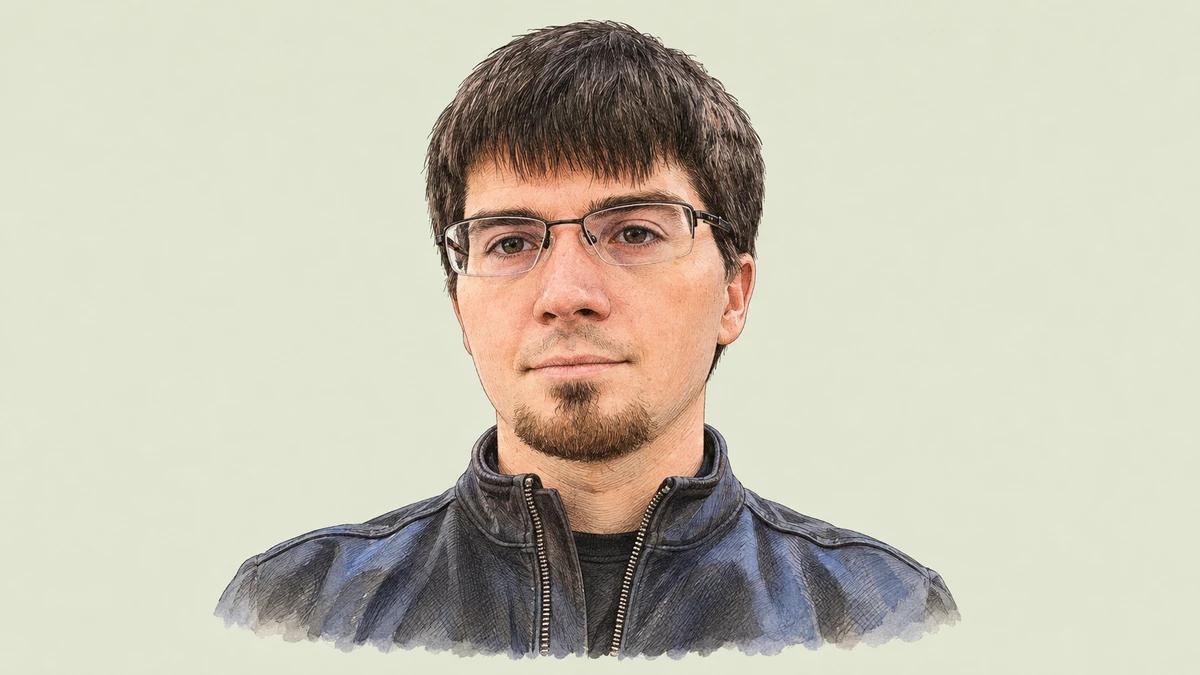
Ian Goodfellow is an AI researcher known for helping develop generative adversarial networks, or GANs, an influential way to train systems that create images. He has also studied how carefully chosen inputs can fool AI systems that otherwise perform well.
The idea behind a GAN is a contest. One learning system produces examples; another estimates which came from the training data and which were generated. The producer gets feedback on its mistakes, while the judge gets new examples to distinguish. Goodfellow and seven co-authors introduced that approach in 2014.
A Classifier Changes His Direction
During a 2006 internship at the U.S. National Institutes of Health, Goodfellow encountered a model that classified events in EEG recordings, which measure electrical activity in the brain.
In a 2025 interview with Mila, he recalled that experience prompting his switch to computer science. At Stanford, he took Andrew Ng's classes and worked on robotics, including summers at Willow Garage.
He later joined Yoshua Bengio's group at the Université de Montréal, then known as LISA. There, he studied with Bengio and Aaron Courville in a research community exploring deep learning.
Deep learning uses neural networks with multiple layers of calculations. Training changes their numerical settings so they become better at a task. For a classifier, that might mean learning which label belongs to a picture. Goodfellow became interested in generating examples as well as recognizing them.
He recalled arriving at the GAN idea about two weeks before a conference deadline. Friends helped with the experiments and theory needed to turn it into a paper.
The resulting “Generative Adversarial Nets” carried the names of Goodfellow, Jean Pouget-Abadie, Mehdi Mirza, Bing Xu, David Warde-Farley, Sherjil Ozair, Courville and Bengio.
How the Contest Works
The two networks have different jobs. The generator makes examples; the discriminator estimates whether they belong to the training collection or came from the generator. Both change as they learn.
Suppose the training pictures are faces. The generator's early attempts may be poor, making the discriminator's task easy. Feedback from the discriminator helps adjust the generator toward more convincing pictures, which in turn gives the discriminator a harder assignment.
Getting that exchange to work can be difficult. In his 2016 GAN tutorial, Goodfellow explained how the two sides can keep changing one another's problem without settling into a useful balance.
A generator can also produce too little variety, a failure called mode collapse. In the face example, it might keep returning variations on a narrow range of faces rather than representing the variety in its training pictures. Convincing individual outputs can hide that weakness.
The idea gave researchers a way to train image generators through feedback from another learning system. Making the contest stable and useful became a research problem of its own.
Faces With More Control
Later teams extended the GAN framework. In 2018, Nvidia researchers Tero Karras, Samuli Laine and Timo Aila introduced StyleGAN, which gave the generator different ways to control variation in its images.
In their face examples, broad features such as pose could be handled separately from finer details such as freckles and hair. Researchers could examine how different controls changed the picture that came out.
GANs became one family of image-generation tools, alongside other methods with different training processes. A decade after the original paper, NeurIPS gave it a Test of Time award.
A Different Kind of Adversary
Even before the GAN paper appeared, Goodfellow was helping examine a surprising weakness in neural networks. A small, carefully chosen change to an image could make a model confidently give the wrong answer, while leaving the picture looking much the same to a person.
In work first released in 2013, Goodfellow and a team led by Christian Szegedy showed how this could happen. Some altered examples also fooled networks other than the one used to create them.
These were adversarial examples: inputs deliberately adjusted to provoke a mistake. A classifier could score well on ordinary test pictures and still have a weakness when tested this way.
Goodfellow, Jonathon Shlens and Szegedy explored the problem further in “Explaining and Harnessing Adversarial Examples,” released in late 2014.
They described an efficient way to calculate input changes that would increase a model's error. Many changes that looked individually small could add up inside the network. Mathematics gave the researchers a damaging direction to follow, instead of leaving them to guess which pixels to alter.
The team also trained models using adversarial examples, improving resistance in their experiments. Here, “adversarial training” meant practicing against misleading inputs. In a GAN, the same phrase describes the contest between a generator and discriminator. The security work was testing whether a model could hold up under attack.
Sharing the Knowledge, Protecting the Records
Goodfellow also helped organize the field into a resource other people could study. With Bengio and Courville, he wrote the MIT Press textbook Deep Learning, published in 2016 and available to read online.
The book moves from mathematical foundations to practical networks and generative models. Readers can work through the calculations behind the demonstrations.
His security interests extended to privacy. With Nicolas Papernot and colleagues, Goodfellow helped develop Private Aggregation of Teacher Ensembles, or PATE, a method for learning from private data while limiting what the resulting model reveals.
Separate “teacher” models learn from separate private datasets. A “student” model learns from their combined votes, with carefully added random noise, instead of receiving the private records directly.
The method lets researchers calculate a privacy bound under specified settings. This limits the extra information that can be revealed because a particular record was used in training. The strength of the protection depends on the chosen settings.
A Turn Toward Fusion
Goodfellow's career has included OpenAI, Google Brain and Apple's Special Projects Group. He later moved to DeepMind; in his 2025 Mila interview, he said concern about climate change helped motivate that move.
Recent work at Google DeepMind has taken him into fusion research. With Jonathan Citrin and colleagues, he developed TORAX, an open-source simulator.
It models plasma, a gas containing electrically charged particles, inside a tokamak, a device that confines the gas with magnetic fields for fusion experiments. The software calculates the movement of heat and particles and changes in electrical current. Researchers can use those simulations to help design experiments and control systems.
In his 2025 account, Goodfellow said much of this work involved writing software to solve numerical equations. It's less immediately visible than a generated face, but it gives a research team something it needs: a way to examine how a difficult physical experiment might behave.
Nicholas Carlini Finds the Cracks in AI
Deepfakes Explained: When a Familiar Face or Voice Can Fool You
Yoshua Bengio's Search for AI We Can Keep Under Control
QUOTE:
"Amateurs hack systems, professionals hack people."